







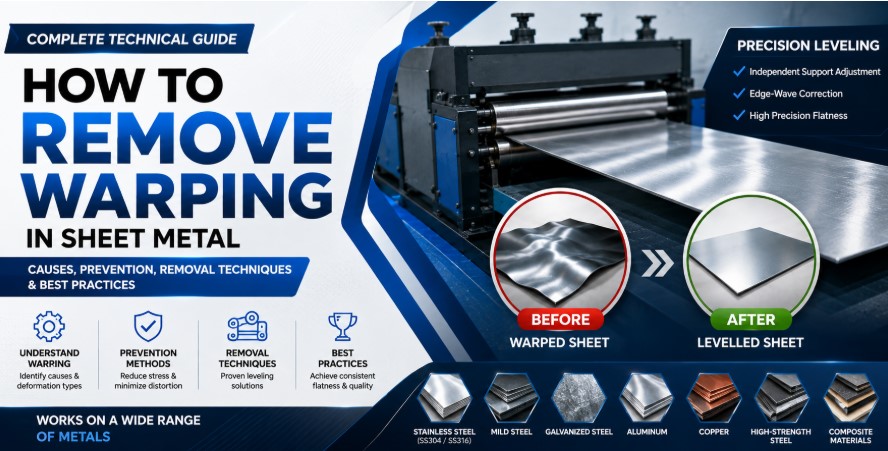











How to Remove Warping in Sheet Metal Complete Technical Guide by IMACHINE
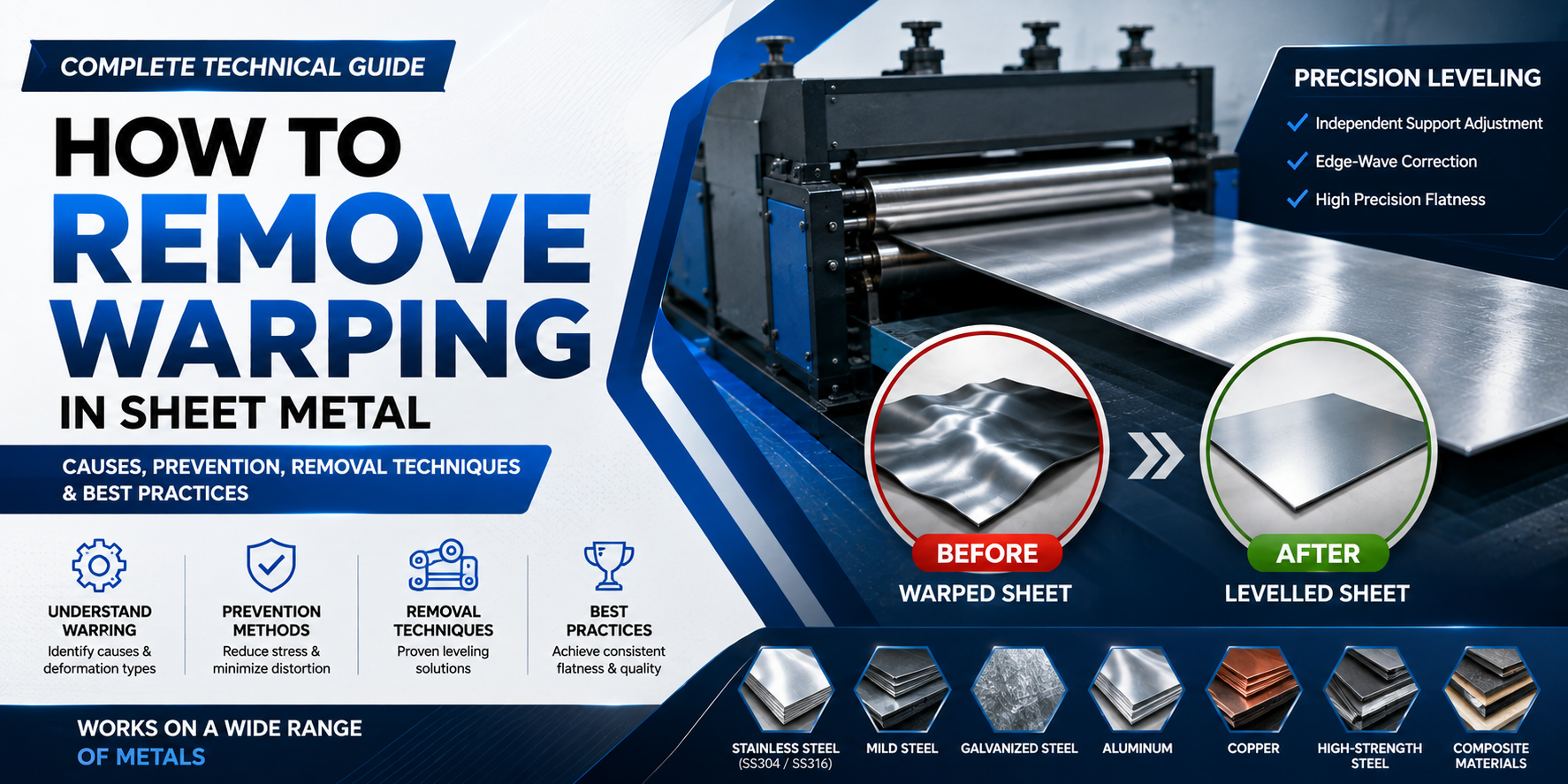
Sheet metal warping can cause dimensional inaccuracies, assembly problems, welding distortion, and surface defects across materials such as stainless steel, mild steel, aluminium, copper, and high-strength steel.
IMACHINE provides fully automatic CNC and hydraulic leveling solutions designed to improve sheet metal flatness, correct edge waves, and simplify maintenance.
In this guide, we’ll explore the causes of sheet metal warping, how to remove it, and how precision leveling technology can improve flatness.
What Causes Sheet Metal to Warp?
Sheet metal warping occurs when stresses are unevenly distributed, either due to thermal or mechanical processes.
Common causes include:
- Laser and plasma cutting
- Welding
- Stamping and bending
- Hot and cold rolling
- Machining
- Annealing
- Coating and galvanizing
Heat is a major cause. Laser/plasma cutting and welding heat the metal, causing expansion and uneven contraction during cooling, which can create distortion.
Common Types of Sheet Metal Warping
Common forms of distortion include:
- Longitudinal bending: The sheet curves along its length.
- Transverse bending: The sheet bends across its width.
- Edge waves: The edges become wavy while the center remains relatively flat.
- Center buckling: The middle section rises or deforms.
- Surface distortion: Localized areas become uneven.
Identifying the deformation pattern helps determine the appropriate leveling method.
How Do You Remove Warping From Sheet Metal?
Precision multi-roller leveling is widely used to correct sheet metal distortion. The sheet passes through multiple rollers, which apply controlled bending to redistribute residual stresses and improve flatness.
Machine settings depend on:
- Material type and grade
- Sheet thickness and width
- Yield strength
- Deformation level
- Required flatness
- Surface condition
The goal is to correct distortion gradually without causing further deformation or surface damage.
Why Is Precision Leveling Useful?
Better Flatness
Improved flatness is essential for precision fabrication and automated production. A flatter sheet supports better dimensional consistency during downstream operations.
Consistent Results
Controlled roller penetration and repeatable settings can help manufacturers achieve consistent results across production batches.
Edge-Wave Correction
Edge waves can be difficult to correct because the deformation is concentrated near the sheet edges. Independent support adjustment provides greater control over roller penetration across the working width.
Improved Downstream Processing
A flatter sheet can improve consistency during:
- Welding
- Bending
- Forming
- Laser cutting
- Machining
- Assembly
Better flatness can also support more reliable positioning in automated manufacturing.
Different Metals Need Different Leveling Approaches
Different materials respond differently to flattening. Factors such as strength, thickness, stiffness, surface condition, and deformation affect the leveling process.
Stainless Steel
SS304 and SS316 can deform from welding, forming, rolling, and thermal cutting. Proper roller diameter, spacing, penetration, and support adjustment are important.
Mild & Carbon Steel
Stamping, forming, welding, and thermal cutting can cause distortion. Controlled penetration and the right roller configuration help correct it.
Galvanized Steel
The zinc coating requires careful handling. Use clean rollers and controlled pressure to avoid damaging the protective layer.
Aluminum
Aluminum is softer and can be easily damaged by excessive pressure. Proper pressure, roller spacing, smooth roller surfaces, and support adjustment are essential.
High-Strength Steel
Its high yield strength makes leveling more challenging. It may require higher pressure, suitable roller diameter, controlled penetration, and hydraulic assistance.
How to Check if Sheet Metal Needs Leveling
Before leveling, manufacturers should identify the type and severity of distortion.
Place the sheet on a known flat reference surface and check for gaps. Depending on the required accuracy, inspection can be performed using:
- Straightedges
- Feeler gauges
- Flatness inspection tables
- Laser measurement equipment
Raised edges may indicate edge-wave deformation, while a raised center can indicate buckling. A curve along the sheet’s length may indicate longitudinal bending.
Manufacturers should also record the material grade, thickness, width, and surface condition before leveling.
Can Warping Be Prevented Before Leveling?
Reducing stress early in manufacturing can minimize the need for later corrections.
Control Thermal Cutting
For laser or plasma cutting, optimize heat input, speed, assist gas, cutting parameters, and sequence. Nitrogen may be used as an assist gas for suitable laser applications.
Reduce Forming Stress
Proper die clearance, forming pressure, tooling alignment, and material positioning help prevent distortion during stamping and forming.
Level Before Welding
Pre-leveling improves assembly accuracy and provides a better base for welding.
Common Sheet Metal Leveling Mistakes to Avoid
- Avoid excessive force: Too much roller penetration can damage the material surface.
- Adjust for material type: Stainless steel, aluminum, galvanized, mild, and high-strength steel require different settings.
- Watch for edge waves: The center may be flat while the edges remain distorted.
- Check final flatness: Always verify that the required flatness is achieved.
CNC vs. Hydraulic Leveling Machines
The right leveling machine depends on the application.
CNC Precision Leveling
CNC leveling machines are useful when manufacturers require accurate, repeatable, and automated control. They can provide:
- Repeatable machine settings
- High precision
- Automated adjustment
- Consistent production results
Hydraulic Leveling
Hydraulic leveling systems are generally suitable for heavier applications where greater force is required, particularly when processing thicker plates or high-strength materials.
Machine selection should consider material, thickness, width, yield strength, deformation pattern, required flatness, and production volume.
What Features Should You Look for in a Leveling Machine?
This versatile system suits manufacturers working with different materials. Key features include individual support adjustment for better control across the sheet width, roller penetration control for different material thicknesses, and automatic roller extraction for easier maintenance.
How IMACHINE Leveling Equipment Addresses Sheet Flatness
IMACHINE manufactures CNC and hydraulic leveling equipment for industrial sheet metal processing. Its multi-roller systems handle various materials, thicknesses, widths, and flatness requirements.
Key features include:
- Independent support adjustment
- Controlled roller penetration
- CNC and hydraulic control
- Edge-wave correction
- Automatic roller extraction
These features provide precise leveling control and consistent sheet flatness.
Final Thoughts
Sheet metal distortion occurs due to uneven internal stresses from cutting, welding, stamping, bending, and rolling. Precision multi-roller leveling helps redistribute these stresses and achieve better flatness. The right leveling method depends on the material, thickness, distortion type, and required flatness, along with factors such as roller design, penetration, machine power, automation, surface protection, and maintenance.