











The architectural and urban design landscapes are undergoing a rapid transformation driven by additive manufacturing, material science and digital workflows. Historically, specifying complex public furniture and architectural products meant navigating harsh trade-offs between design ambition, manufacturing costs and heavy physical footprints. Today, advanced technologies are dismantling these constraints, allowing designers to create expressive, circular and highly efficient architectural elements at scale.
Unlocking Unprecedented Design Freedom
At the core of this technological evolution is the ability to bypass traditional mould making. Subtractive manufacturing and concrete casting require expensive, single-use or limited-run forms that penalise organic, non-linear designs. Large-format 3D printing removes these constraints entirely, translating digital 3D models directly into physical structures layer by layer.
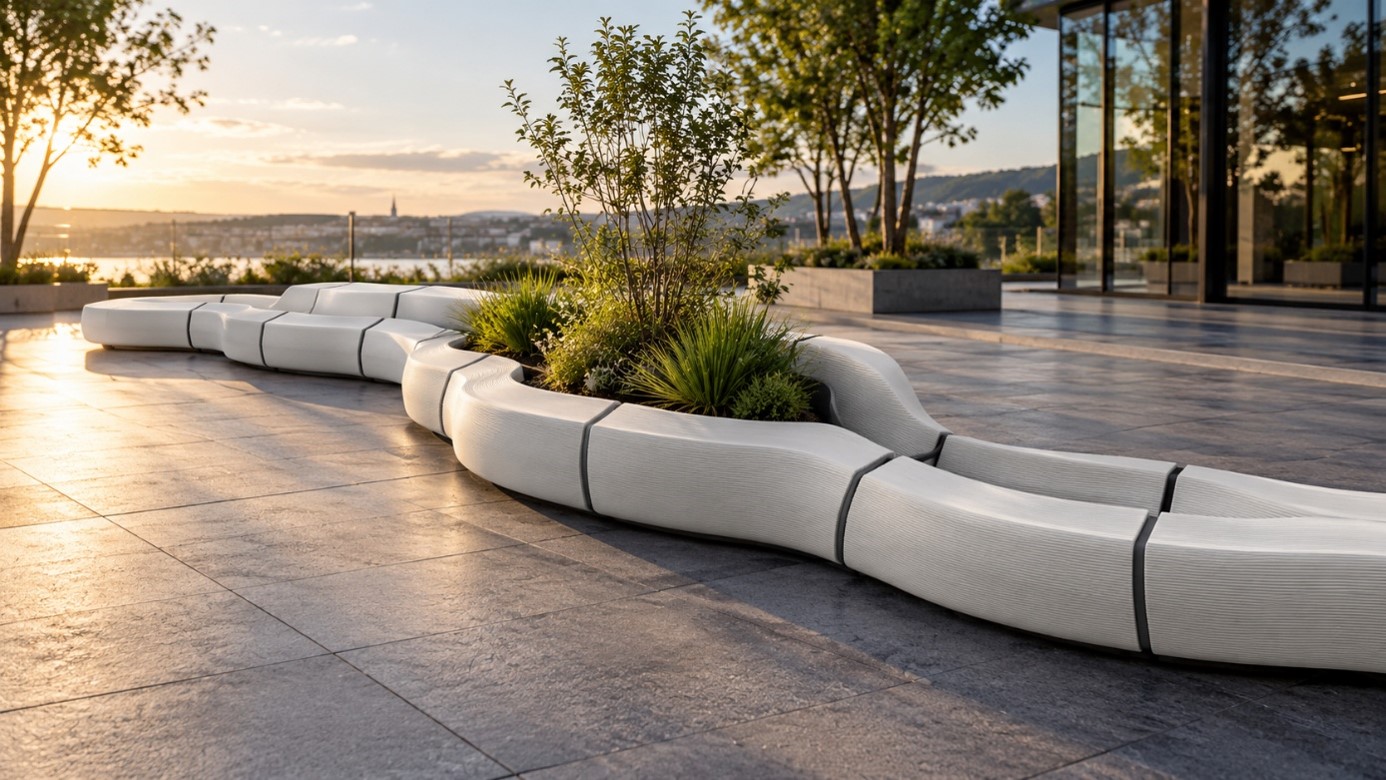
A prime example of this design evolution in urban furniture is the award-winning ONTIGO 10 3D printed benches manufactured by German street furniture specialist BENKERT. Recognised with both the Red Dot Award: Product Design and the iF DESIGN AWARD, the ONTIGO 10 demonstrates how additive manufacturing allows for fluid, continuous curves and ergonomic forms that would be virtually impossible or financially prohibitive to cast using traditional methods.
Beyond pure silhouette, 3D printing introduces subtle tactile and visual depth to architectural surfaces. The layer-by-layer deposition process leaves a signature fine-grooved, tactile surface that catches natural light dynamically across its curves. Crucially, this textured finish offers functional benefits: it incorporates engineered micro-channels for rainwater runoff, supporting a self-cleaning effect that helps shed surface dirt in outdoor environments.
Material Innovation and the Circular Economy
Modern architectural products are no longer evaluated solely by their strength and appearance, but also by their environmental footprint and embodied carbon. Additive manufacturing acts as a catalyst for circular material concepts, allowing industrial waste streams to be transformed into high-performance structural elements.
In progressive architectural manufacturing, recycled polymers are increasingly combined with reinforcement technologies to deliver robust, weather-resistant solutions. For instance, the main bodies of modern printed street furniture can be crafted entirely from 100% recycled industrial films. To ensure these components withstand heavy public use, harsh weather conditions and UV exposure, the recycled base polymer is enhanced with glass fibre reinforcement and integrated with powder-coated stainless steel components. This hybrid material strategy ensures that sustainability does not compromise longevity or structural integrity, establishing a blueprint for true circular economy practices in municipal infrastructure.
Weight Reduction and Site Efficiency
One of the most immediate practical benefits is the dramatic reduction in physical mass. Consider traditional urban seating: a substantial, double-sided concrete bench can easily top several tonnes, creating a heavy burden across the entire supply chain. By contrast, an additive-manufactured component using optimised hollow or ribbed internal structures achieves comparable stability with a fraction of the mass. A single printed seating element in a high-performance polymer setup might weigh as little as 177 kg – a stark contrast to a comparable cast-concrete counterpart, which can weigh upwards of 3,800 kg.
This radical reduction in weight yields substantial advantages:
- Lower transport emissions: transporting lightweight components requires fewer heavy-goods vehicles, reducing the carbon footprint associated with shipping and logistics.
- Simplified installation: heavy machinery, such as specialised mobile cranes, is no longer necessary for installation. Smaller crews using standard equipment can manoeuvre and anchor the elements efficiently.
- Versatile site placement: lightweight structures can be installed in weight-sensitive locations, such as roof gardens, elevated plazas or atop underground car parks, where concrete structures would exceed load limits.
Modular Systems and Digital Integration
Modern manufacturing technologies do not operate in isolation; they are deeply integrated into contemporary digital planning workflows. Today’s architectural products are engineered as adaptable, modular systems designed to interface smoothly with Building Information Modelling (BIM) and computer-aided design (CAD) software.
Modular design strategies allow a set of standardised printed elements to be combined in virtually endless configurations. For example, a system comprising 21 standard modules can be seamlessly combined and extended to form continuous serpentine seating runs, curved islands or compact resting spots. Furthermore, these modular bases can be customised on demand with integrated accessories, such as planters, ergonomic backrests, armrests or built-in side tables, providing flexible functionality tailored to the specific needs of a community space.
To support urban designers and architects during the concept and detailed design phases, manufacturers now supply ready-to-use digital planning assets. Providing digital datasets in universal formats such as DWG and STEP allows specifiers to drag and drop precise geometric models directly into their spatial plans. This ensures accurate spatial coordination, more precise cost estimates and smoother approval processes before a single module is printed.
The Future of Public Space Design
The evolution of architectural products through 3D printing, advanced circular materials and digital workflows marks a crucial turning point for urban design. By decoupling complex form-making from high manufacturing costs and heavy environmental footprints, new technologies enable cities to become more vibrant, adaptable and sustainable. Products such as BENKERT’s ONTIGO 10 highlight how everyday urban infrastructure can embrace cutting-edge manufacturing to offer low-impact, highly functional and visually striking solutions for modern public realms. As these technologies continue to mature, the boundary between visionary architecture and sensible product manufacturing will continue to blur, ushering in a more creative and sustainable built environment.