




















On many commercial schemes, the car park gets far less design time than the building. Then the site opens, and the first complaints arrive: cars moving too fast down the aisles, near misses at the entrance, delivery vans rushing to the loading bay. Fixing this after handover is harder and more disruptive than planning it from the start, because the car park is where cars, vans, pedestrians and trolleys all share the same space.
Keeping vehicle speeds low is the simplest way to make that space work. Speed bumps do this without staff, power or ongoing costs, and they suit both new-build schemes and existing sites. Used well, they make a car park calmer and safer. Used badly, they just annoy drivers. Here is how to get them right.
Managing Vehicle Speeds in Busy Parking Areas
Speeds in car parks creep up for simple reasons. Long, straight aisles invite drivers to accelerate. People hunting for a space look left and right instead of ahead. Others rush to leave. Meanwhile, pedestrians step out between parked cars, often with children or trolleys, and are hard to see.
Many car parks post a 5 or 10 mph limit, but a sign alone rarely changes behaviour. A speed bump does, because drivers feel it. At low speed, a driver has time to react when someone appears from behind a van.
Placement matters more than the number of bumps. The most useful spots are:
- Entrances and exits, where drivers arrive from faster roads or hurry to leave.
- Long, straight aisles, at regular intervals so drivers do not speed up between bumps.
- Just before pedestrian crossings and building entrances.
- Near loading bays and delivery routes, where large vehicles reverse and turn.
Avoid putting bumps on tight bends or in the middle of a turn. Check emergency access routes with the fire safety adviser at design stage, and leave space for drainage so water does not collect behind the bump. On mixed-use schemes, think about the neighbours too: vans crossing bumps late at night can be noisy, so keep bumps away from residential windows where possible.
Combining Speed Bumps with Road Markings and Signage
A speed bump works best as part of a system. On its own, it can surprise drivers and become a trip hazard for pedestrians. Together with signs and markings, it tells everyone what to expect.
Start at the entrance. A sign showing the speed limit and warning of speed bumps ahead sets the rules before the first bump. Inside the car park, keep the message consistent. The same colours, the same signs and the same type of bump across the site help drivers read the layout quickly.
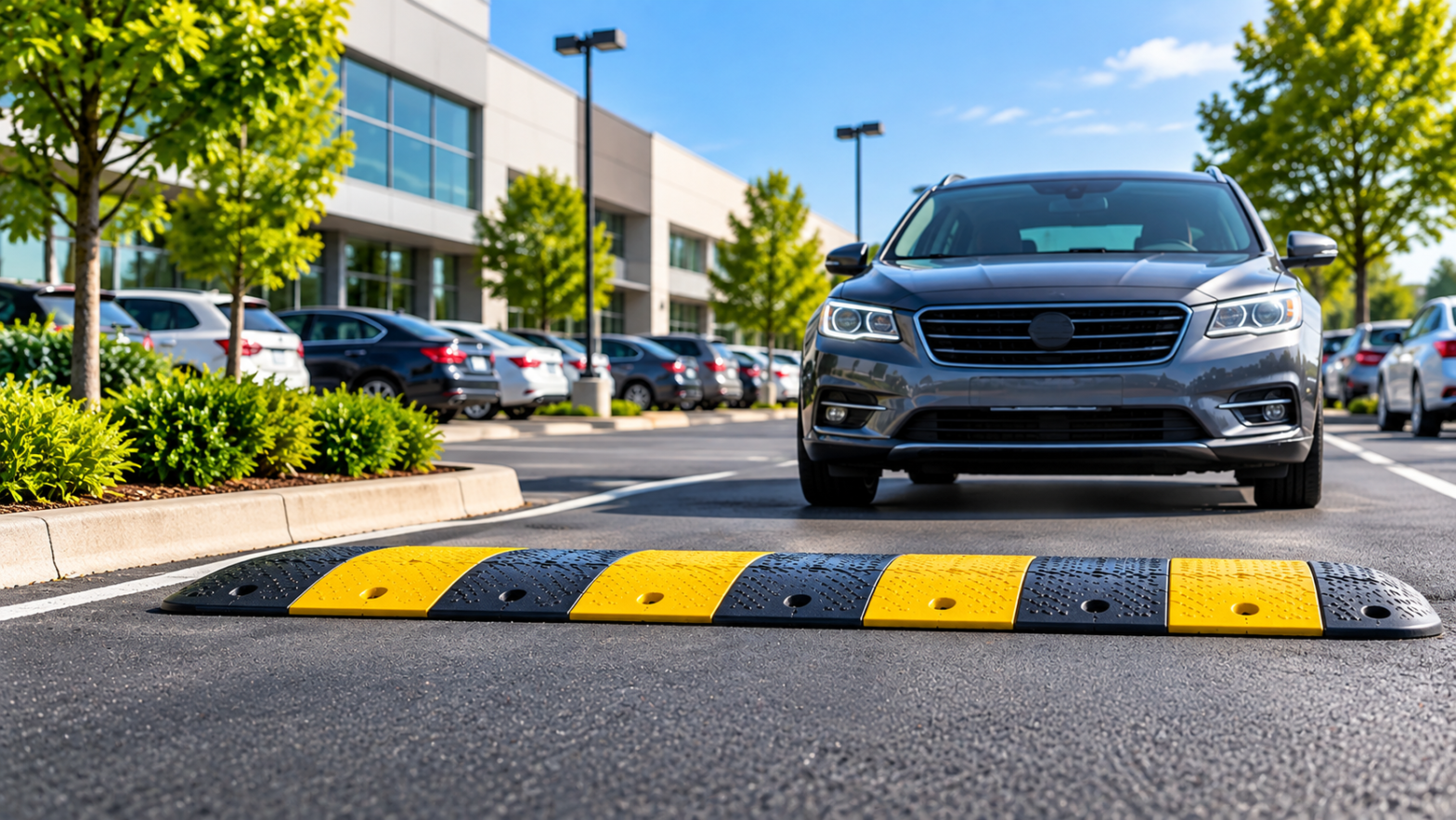
The bump itself must be easy to see. Yellow and black bumps, or yellow end caps on black rubber, stand out in daylight. Reflective inserts and good lighting keep them visible at night and in rain. Where paint is used on the surface, refresh it when it wears.
Speed bumps also work well with pedestrian routes. Placing a bump just before a marked crossing slows drivers exactly where people walk, without asking pedestrians to step over it. Keep the crossing itself level and step-free, so wheelchair users and people with pushchairs can cross easily. Clear arrows and one-way systems reduce the number of places where vehicles meet head-on, so fewer bumps are needed overall.
Choosing the Right Speed Bumps for Different Traffic Conditions
The first choice is between a speed bump and a speed hump. People often mix them up. A speed bump is short and fairly sharp, and it brings vehicles down to walking pace. That makes it the usual choice for car park aisles. A speed hump is longer and gentler, and it suits access roads within a site where traffic should move a little faster.
Next, think about the traffic:
- Cars only: a lower profile keeps the ride comfortable and protects low bumpers.
- Vans and lorries: delivery areas need stronger sections and heavier fixings.
- Mixed and busy: modular bumps let you build the exact width needed for each aisle.
Material is the third decision. Modular rubber, often made from recycled tyres, is the most common option. It is bolted down in sections, so a damaged piece can be replaced on its own, and the whole run can be moved if the layout changes. That is useful on phased developments and temporary site compounds. It also supports sustainability goals: recycled rubber gives old tyres a second life, and the modules can be lifted and reused on another site instead of being broken out and thrown away. Plastic bumps are lighter and suit lighter traffic. Asphalt bumps are permanent and part of the surface, but changing them means resurfacing.
When talking to speed bump suppliers, ask which vehicles each model is designed for, what fixings are included, how the units are made visible at night, and which standards the product meets. Clear answers to these questions are a good sign of a product that will last.
Conclusion
Speed bumps are a small item on a large project, but they shape how people feel in a car park every day. Placed at the right points, combined with clear signs and markings, and chosen for the vehicles on site, they keep speeds low and pedestrians safe. Plan them early with the rest of the layout, and they will do their job quietly for years.