



















Insulating a home can reduce unwanted heat transfer and make indoor temperatures easier to maintain, but choosing insulation is not simply a matter of finding the thickest product available.
Different parts of a property require different solutions and insulation materials themselves vary considerably in thermal performance, fire behaviour, moisture characteristics, cost and installation requirements.
Understanding those differences is essential before deciding how to improve a home.
Why insulate a house?
Heat naturally moves from warmer areas towards colder ones. During winter, that means heat generated inside a home continually escapes through the building fabric.
Walls, roofs, floors, windows and gaps around the structure can all contribute.
Insulation slows this transfer of heat. The result can be a property that retains warmth for longer and requires less energy to maintain a comfortable internal temperature.
Insulation can also improve comfort by increasing internal surface temperatures and reducing the pronounced cold-wall effect associated with poorly insulated buildings.
However, insulation needs to be approached as part of the building as a whole. Ventilation, moisture management, heating and airtightness all interact.
External wall insulation
External wall insulation, often abbreviated to EWI, involves attaching insulation to the outside face of the external walls before covering it with a reinforced protective layer and decorative finish.
It is particularly relevant to properties with solid walls, although it can be used on other suitable constructions when correctly designed.
One of its main benefits is that a continuous layer of insulation can cover much of the external envelope. This can help reduce thermal bridging at locations where internal insulation may be interrupted by floors and internal walls.
There is also relatively little disruption to internal rooms.
The disadvantages are mostly associated with the scale of the work. External insulation changes the dimensions and appearance of the facade, so details around windows, doors, rooflines, pipes and other penetrations need careful consideration.
Planning requirements may also need to be checked, particularly on listed buildings or properties in conservation areas.
Internal wall insulation
Internal wall insulation places insulation on the room side of an external wall.
This can be useful where the outside appearance of a property cannot be altered or where work is only being carried out on selected rooms.
It can also be completed without scaffolding around the entire property.
The obvious disadvantage is the loss of some internal floor area. Electrical sockets, radiators, skirting boards and other fittings may also require repositioning.
Moisture risk requires particularly careful assessment. Adding insulation changes the temperature profile through the wall and an unsuitable build-up can create condensation problems within the construction.
For that reason, internal wall insulation should be designed around the existing wall rather than treated as a simple lining exercise.
Loft and roof insulation
Because warm air and heat can escape through the upper part of a building, loft insulation is often one of the most straightforward areas to improve.
Where the loft is not being used as a heated room, insulation is commonly installed at ceiling level.
If the roof space forms part of the occupied building, insulation may instead be placed within the roof structure.
Care needs to be taken around ventilation paths, electrical equipment and areas where the insulation layer is interrupted.
Floor insulation
Ground floors can also contribute to heat loss.
The appropriate approach depends heavily on the construction.
Suspended timber floors may allow insulation to be installed between joists, whereas solid floors generally require a different solution. Major floor upgrades are often easier when undertaken alongside renovation work because changes to finished floor heights can affect doors, stairs and other details.
EPS insulation
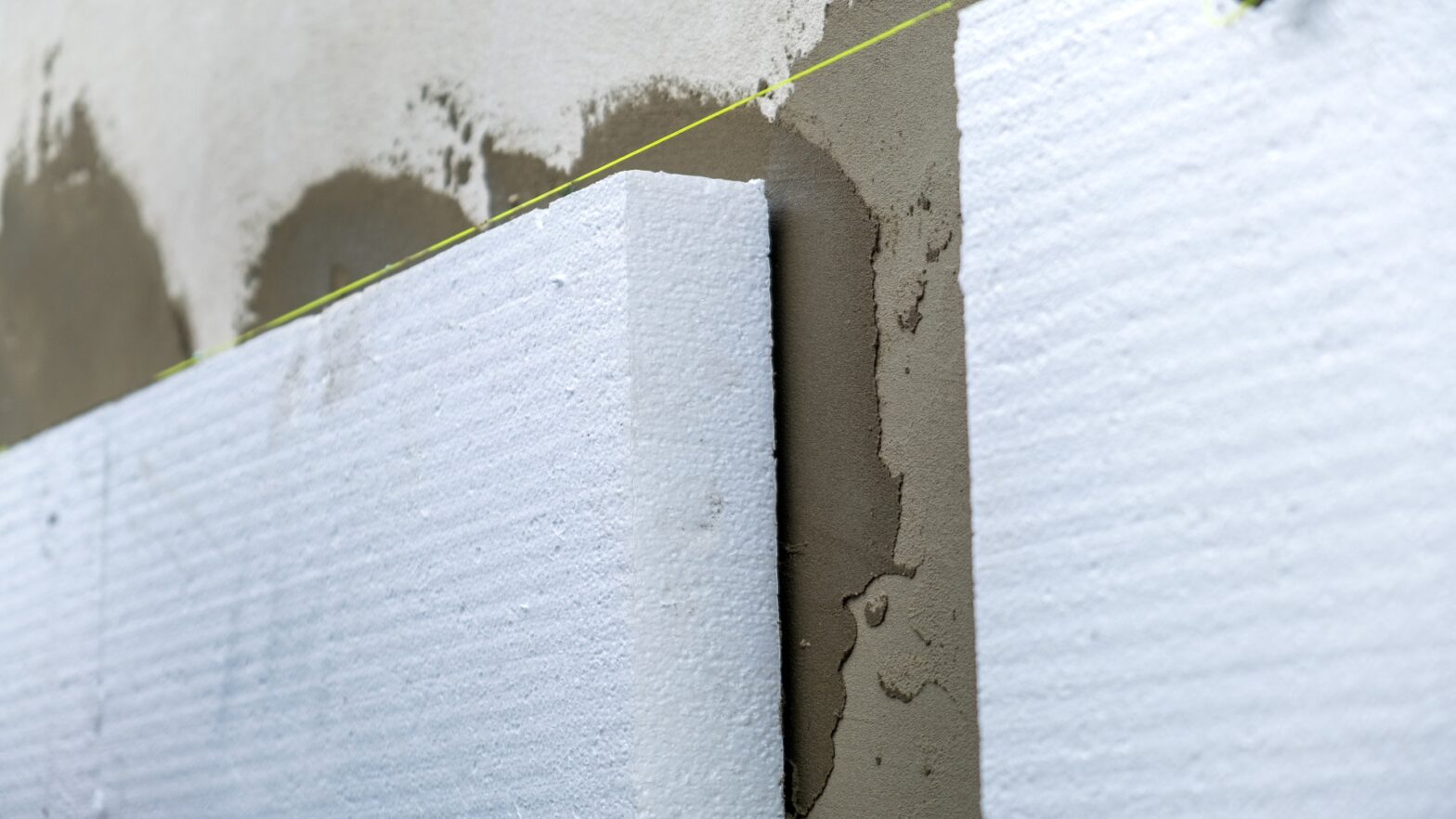
Expanded polystyrene, or EPS, is widely used within external wall insulation.
Graphite-enhanced EPS incorporates particles that improve its thermal performance compared with conventional white EPS, allowing effective insulation without excessive thickness.
It is lightweight, relatively easy to cut and generally cost effective, which helps explain its popularity.
Like any insulation, however, it must be used as part of a correctly designed system.
Mineral wool
Mineral wool is manufactured from mineral fibres and offers a different set of properties.
It is commonly selected where fire performance, vapour permeability and acoustic performance are particularly important.
Its fibrous structure also makes it fundamentally different to rigid foam insulation.
Mineral wool external wall insulation slabs are usually denser than rolls used in lofts because the boards must provide a stable surface for the subsequent reinforced render system.
They can be heavier and more labour-intensive to handle than EPS, which can affect project cost.
Phenolic insulation
Phenolic boards are high-performance rigid insulation products.
Their main advantage is the amount of thermal resistance that can be achieved within a relatively limited thickness. This can make them valuable where space is restricted, such as around narrow pathways, roof overhangs or window reveals.
Higher-performance products generally command a higher material cost, so there is a balance between achieving a slim construction and controlling the overall budget.
XPS insulation
Extruded polystyrene, usually known as XPS, has good resistance to moisture and compression.
These characteristics make it useful in locations where insulation may encounter higher moisture levels or physical loads.
Within external insulation work it can be specified for particular details, depending on the system design, rather than automatically being used across the complete facade.
Wood fibre insulation
Wood fibre is increasingly considered for projects where vapour permeability and the use of renewable materials are priorities.
It is particularly associated with breathable wall systems and can work well with compatible lime-based materials.
Its properties and installation requirements differ from foam insulation, so the full wall build-up must be designed accordingly.
For homeowners comparing the available choices, a specialist Insulation shop like EWI Store can provide a useful overview of the different insulation boards, fixings, basecoats and finishing materials involved in various systems. Our current external insulation range includes graphite EPS, mineral wool, phenolic, XPS and wood fibre options.
What are the disadvantages of insulating a house?
Insulation has significant potential benefits, but poor specification can cause problems.
The most important consideration is moisture. Insulation changes how heat and moisture move through a wall, roof or floor. Existing damp problems should therefore be investigated rather than simply covered.
Detailing is equally important. Gaps in insulation can create thermal bridges and poorly considered junctions around windows or rooflines can undermine performance.
Cost is another factor. Some measures provide a faster return than others and the appropriate investment will vary considerably between properties.
Choosing the right approach
Start by understanding the building.
Its age, wall construction, existing insulation, exposure and condition will determine which options are realistic.
A modern cavity-wall home has very different requirements from a Victorian solid-brick terrace. Similarly, a stone cottage needs a different moisture strategy from a newer concrete-block property.
Rather than selecting an insulation material first, establish the performance and technical requirements of the building and then select a system capable of meeting them.
Frequently asked questions
What type of insulation is best for external walls?
There is no universal answer. EPS is popular for thermal performance and affordability, mineral wool offers strong fire and acoustic characteristics and phenolic boards are useful where a thinner build-up is required. The property and system specification should determine the choice.
Does thicker insulation always perform better?
For two boards made from the same material, increased thickness generally increases thermal resistance. However, different insulation materials have different thermal conductivities, meaning a thinner high-performance board may outperform a thicker board made from another material.
Can insulation cause damp?
Correctly designed insulation should not simply cause damp, but an unsuitable build-up can change moisture movement and increase condensation risk. Existing damp should always be investigated and ventilation and moisture management considered as part of the project.
Is it worth insulating one part of a house at a time?
It can be. Loft insulation, for example, may be completed independently of external wall insulation. However, thinking about the property’s long-term retrofit plan can help avoid incompatible work or details that later need to be altered.