



















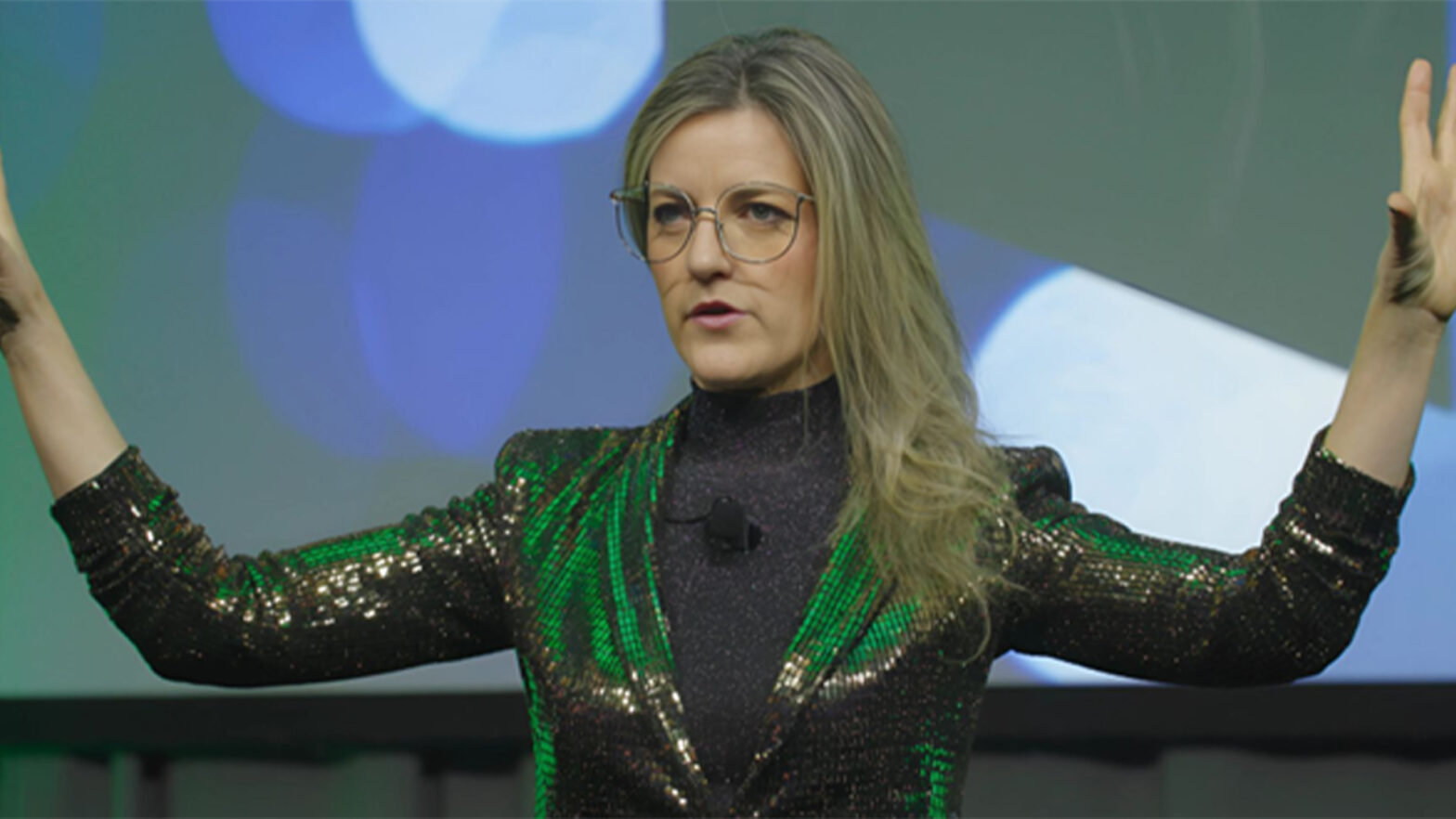
This exclusive interview with Nikki Greenberg was conducted by Tabish Ali of the Motivational Speakers Agency.
Cities are no longer just streets, offices and homes. Nikki Greenberg argues they are becoming digital systems, where AI, robotics, cloud technology and real estate now decide how people live, work, travel and spend their time.
Nikki Greenberg is a real estate futurist and technology strategist who has worked across the US, Asia, Europe, Africa and Australia. Her background includes leading the digital transformation of QIC’s $17 billion real estate portfolio and $4 billion development pipeline, as well as driving innovation at New York brokerage Brown Harris Stevens.
Now a futurism & trends expert, Nikki speaks about the future of cities, real estate, Gen Z, digital workplaces and the point where physical space and cyberspace collide. Her message is direct: businesses cannot treat technology as something separate from buildings, people or culture. It is already changing all three.
In this exclusive interview with the AI Speakers Agency, Nikki Greenberg explains why the future of cities is already arriving, how digital transformation is changing real estate, what businesses still misunderstand about Gen Z, and why motivation matters more than old ideas of mental toughness at work.
Question 1. Cities are being reshaped by AI, robotics and climate pressure. What does the city of the future actually look like?
Nikki Greenberg: “I think we all know that at the moment cities are going through a full transformation, and it’s something that’s quite exciting because what we’re seeing now is that cities are truly embracing the digital way that we live, work and play.
“Back in the 40s to 60s, a lot of cities became very reliant on cars. Because of cars, we saw big highways, the birth of suburbia, and cities really spreading out.
“What we are seeing now is the way cities are transforming because of technology, like AI, the cloud and robotics.
“Today, cities are transforming in a way that asks: how can people interact with cities? What’s going to drive them in? What’s going to make cities more productive, more sustainable, more resilient and better places to live?
“How do we design the future of cities in a way that is more engaged with technologies and also a better place for people to live in the long term?
“We all know that cities are big and complicated, and a lot of these are big-picture projects.
“For me personally, I live in New York, and it is arguably the most exciting city on earth. I think there would be many people who would support this point of view.
“Sitting where I am at the moment, to see the way it is transforming and the types of innovations that are coming out, and being part of that conversation, is incredibly exciting.
“Being part of roundtables where we are sitting down with government officials and visiting dignitaries, talking about ESG, resilience, climate change, and knowing how technology can support these goals, is something incredibly exciting.
“There is a lot of different thinking going on, from change of use from office to residential, invigorating the streets and improving transportation, which might be closing down roads or bringing in flying taxis.
“It is the most exciting time to be working in this space and looking at the future of cities.
“For me, if there is anything I would like to close on, it is this: the future is not just coming, it is already here.
“What is most important for all of us, no matter where you work, what type of organisation, or what level of organisation you are in, is that we need to make the changes today to create the future of tomorrow that we want to see.”
Question 2. Real estate has been slow to change, but digital technology is now reaching everything from construction to how people use buildings. How far is this transformation going?
Nikki Greenberg: “It is a very exciting time for the real estate industry. It is going through a full digital transformation at the moment, very similar to what a lot of us will have experienced in banking.
“Now you can do all of your banking on an app.
“What is starting to happen is that the way we interact with buildings is all going to be completely digitised, but it is a big journey.
“So, what does digitisation look like?
“It happens across the board. It happens from the design and construction of a building through to the way that it is actually used.
“Can you turn on the light switch? Can you find parking? Can you make sure the air conditioning is at the right temperature and preserving energy, for example?
“It also goes through to the way it is sold and transacted, having that data to make sure big decisions are being made.
“What we are seeing is that the physical space and cyberspace are starting to merge together, and this is something that is really exciting.
“In the keynotes that I give to the real estate industry, what I am interested in presenting to audiences is the trends and technologies impacting the industry, and how they can start to identify new opportunities that can give them an edge.
“It is about looking for opportunities where others might not be looking, seeing how we can cut costs, have a better product, create a better experience and make properties future-ready.”
Question 3. Gen Z are already changing the workplace and consumer markets. What are businesses still getting wrong about how to reach them?
Nikki Greenberg: “They are a really unique generation that just does not get enough credit.
“Today, they are already the largest global population group, and they are the first generation to have never known a world without the internet.
“The way they engage with the world is hyper-connected, hyper-digital and hyper-engaged.
“They are super savvy and super smart. So, for businesses, there is a challenge.
“The statistics show that even this year, in 2023, 70% of Gen Zeds are thinking about changing jobs, which to me is incredibly sad.
“It shows they are disengaged and not being utilised in the workforce in the way that they want to be.
“For Gen Z, we have to think about what this generation wants. How do they think? What motivates them? How can we appeal to them?
“Gen Z have a lot of unique attributes.
“They are digital natives, so they are hyper-connected. They have, on average, 10 devices that they are using. They are flicking between devices.
“You cannot have an analogue workplace. That does not work for them. You want to have a digital personal experience.
“We know that the environment really matters to Gen Z. We have seen them as eco-warriors. They are out protesting about climate change and saving the world.
“How can a workplace appeal to them in that way?
“Gen Z are also a generation that love to express what they are talking about. They expect personalisation. They want to be engaged as an individual.
“There are a lot of things workplaces should be doing and can be doing to engage with this generation.
“What I am very passionate about is seeing how we can appeal to them in the right way, keep them engaged and bring out their best and highest passion for what they do.”