










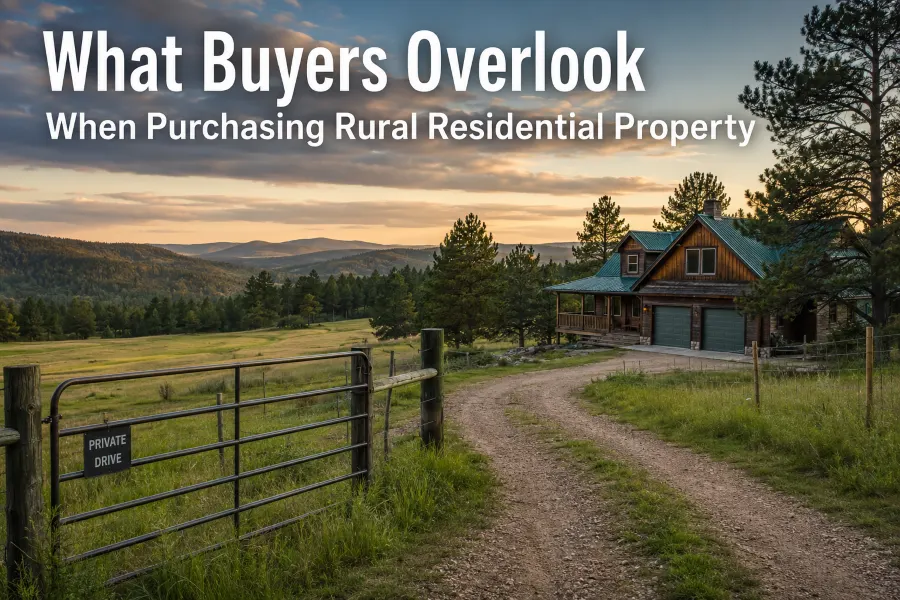











Key Takeaway: Buyers often overlook the practical details that determine whether a rural residential property is truly usable, affordable, and livable long term. Road access, water, septic, utilities, zoning, easements, boundaries, and fire risk should be reviewed carefully before making an offer on a rural residential property.
Rural residential property attracts buyers for good reasons. More space, quieter surroundings, views, privacy, and room for a different daily life all carry real appeal. That is why interest in Black Hills land for sale often starts with a dream: acreage, trees, a shop, a garden, horses, or fewer neighbors in sight. But the strongest buyers do not stop at the dream. They study what the property will require after closing.
Rural Property Should Be Evaluated as a System
In our work at The Black Hills Real Estate Group, we’ve seen buyers focus first on the house, acreage, views, and distance from town. Those details matter, but rural residential property functions as a system. Access, water, septic, utilities, zoning, drainage, fire risk, and boundaries all affect whether the property will be comfortable, affordable, and practical long-term.
A beautiful property can still carry expensive obligations. A peaceful driveway can require private maintenance. A large parcel can include limited usable land because of slope, easements, setbacks, or soil conditions.
Road Access Can Become a Real Ownership Cost
Road access is one of the most overlooked issues. Buyers should confirm whether the road is public, private, shared, or seasonal. In areas outside Rapid City, Custer, Hill City, Spearfish, and other Black Hills communities, road ownership and maintenance can vary from property to property.
A tucked-away road may offer privacy, but it can also bring snow removal, grading, shared repair costs, and access concerns during storms. Anyone considering buying rural property in the Black Hills should ask whether a recorded road maintenance agreement exists, who pays for repairs, and whether the property remains accessible to emergency vehicles year-round.
Water and Septic Deserve More Than a Quick Glance
Many rural homes rely on private wells and septic systems. These are essential systems that affect health, financing, maintenance, and resale.
A well should be evaluated for water quality, pressure, production rate, age, and service history. A working faucet does not prove the well can support normal household use through every season. Septic systems need the same level of review. The U.S. Environmental Protection Agency provides a homebuyer guide explaining how septic systems work and why inspection matters before purchasing a home with one. A proper inspection can reveal age, capacity, drain field concerns, and signs of failure. That matters because septic repairs can be costly and may be limited by soil or site conditions.
Internet, Cell Service, and Utilities Shape Daily Life
Buyers often underestimate how much rural utilities affect convenience. Internet speed, cell reception, propane access, trash pickup, electric service, and backup power options should be checked before making assumptions.
This matters because many buyers expect rural property to support remote work, online schooling, smart security, and streaming. A home that feels perfect during a weekend showing may feel frustrating if internet cannot handle weekday work. Buyers should test cell service on-site, ask about actual internet providers, and confirm utility arrangements before relying on broad coverage maps. Understanding these systems is especially important when comparing off-grid vs on-grid cabins in South Dakota, as utility access can have a major impact on daily life.
Zoning, Easements, and Land Use Rules Can Limit Plans
Acreage does not automatically mean unlimited freedom. Rural residential property can be affected by county zoning, subdivision covenants, utility easements, access easements, building setbacks, short-term rental rules, and limits on accessory structures.
This is where buyers make avoidable mistakes. They assume that because a property looks rural, it will allow livestock, guest cabins, shops, fences, or future subdivision. That may not be true. A buyer who wants horses, a vacation rental, a second dwelling, or a home-based business should verify rules before the offer becomes final.
The smarter approach is to match the property to the intended use. If the goal is privacy, confirm neighboring access rights. If the goal is expansion, review setbacks and septic capacity. If the goal is animals, confirm zoning, fencing, water, and land suitability.
Boundaries and Usable Land Are Often Misread
Fence lines do not always equal property lines. Driveways, sheds, trails, and open meadows may not sit where a buyer assumes they do. On rural land, that can affect privacy, building plans, resale, and relationships with neighbors.
Buyers should review the legal description, title work, recorded plats, and any existing survey. Usable land should also be evaluated carefully. Ten acres on paper can feel very different if much of it is steep, rocky, wooded, wet, or difficult to access.
Fire Risk, Drainage, and Weather Exposure Need Serious Attention
The Black Hills have their own ownership realities. Trees, slopes, wind exposure, snow, drainage patterns, and wildfire risk can all shape the long-term cost of owning rural property. The USDA Forest Service notes that Black Hills National Forest fire response occurs year-round, with the primary fire season running from May through October.
That does not mean buyers should avoid wooded or rural settings. It means they should evaluate them honestly. Defensible space, driveway access, roof materials, tree density, water availability, and insurance requirements should all be part of the conversation. Drainage deserves attention. Low spots, washed-out driveways, erosion, and poor grading can create recurring maintenance problems.
Final Takeaway
The best rural residential purchase is the one that fits both the dream and the maintenance reality. Buyers should look past the views and ask better questions about access, water, septic, utilities, zoning, easements, boundaries, insurance, fire risk, and daily convenience.
Before making an offer, gather records, walk the property carefully, ask direct questions, and bring in the right inspectors or local professionals. Rural living can be deeply rewarding in the Black Hills, but it rewards buyers who do careful due diligence before they commit.