





















For developers and project managers running tight construction programmes, the cost of a cable strike is rarely the bill that hurts most. The damage to the schedule is. A single significant strike can produce a chain of programme consequences that no amount of contingency planning fully absorbs.
Construction programmes are built on a series of dependencies. Groundworks finish before foundations. Foundations finish before the frame. Frame finishes before envelope. Every following trade is sequenced against the trade in front of it, and slippage in the early stages compounds through everything that comes after. When an excavation strikes a high-voltage cable, a gas main or a fibre trunk route, the programme effect is not the time it takes to repair the damage. It is the time it takes for the site to stop, for the investigation to complete, for the third party to release the site back to the contractor, and for the following trades to be rescheduled around the resulting gap. That sequence typically runs from a few days to a few weeks, and on a development with liquidated damages attached, the cost is measured in line items most contractors would rather not see in print.
The brand that has spent the longest time looking at where strike risk actually originates is Sygma Solutions. The UK’s only independent specialist in underground utility location training has spent more than twenty years delivering cable avoidance training to major utilities, infrastructure and construction clients. The data the family-run Cheltenham business pulls back from those clients points to a clear pattern: most strikes are not caused by missing certificates or faulty equipment. They are caused by recurring behavioural shortcuts that proper training is supposed to eliminate, and which substandard training fails to address.
What strikes actually do to a programme
The headline cost of a strike is the repair bill. For a major utility hit, that bill alone runs from several thousand pounds into the tens of thousands. The third-party compensation that follows can dwarf it, particularly on telecoms and power assets, where downstream service outages produce their own claims. Insurance premiums climb at the next renewal. Excess payments hit the current claim. The HSE investigation absorbs management time across the project. And if injury is involved, the prospect of prosecution under the Construction (Design and Management) Regulations 2015 brings its own legal and reputational weight.
The schedule damage runs alongside all of this. The site stops for the duration of the emergency response and the asset owner’s repair work. The trades behind the groundworks are stood down or redeployed. The trades in front of them, if any are working concurrently, often have to pause their own work for safety reasons. The programme baseline shifts. Float disappears. Critical path activities slip. On a development with a fixed handover date and liquidated damages, the financial consequences of that slippage frequently exceed the direct cost of the strike itself.
For developers and PMs, that is the relevant arithmetic. The cost of preventing strikes, distributed across a workforce and several years of training, is a small fraction of the cost of one programme slippage event traceable to one operative skipping one step in one survey.
Where training falls short
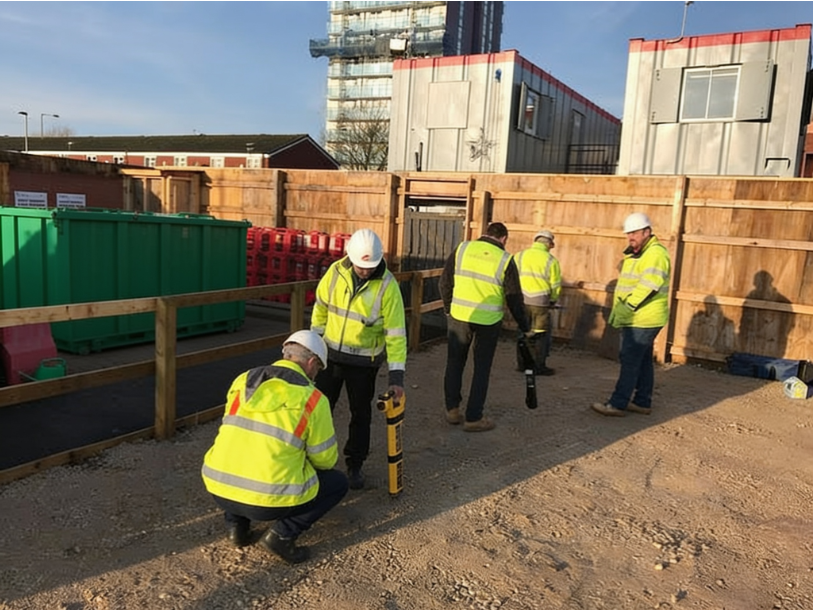
The default cable avoidance training across the UK construction sector is a half-day course covering both the Cable Avoidance Tool and the signal generator known as the Genny. The certificate that follows satisfies procurement requirements and goes on the operative’s file. The training, in many cases, does not survive contact with the first dig. Operatives revert to using the CAT in its passive modes alone, leaving the Genny in the van, because that is the faster way to clear a site for excavation under programme pressure.
The behavioural consequence is significant. The CAT in passive mode misses services routinely. Unenergised cables, balanced three-phase loads, short metallic runs without enough re-radiated signal: all of these can sit invisible under a passive scan. The Genny applies a known signal to a target conductor, which is what transforms detection accuracy. Skipping it is the single most common shortcut on UK excavation sites, and it is the shortcut directly responsible for a meaningful share of the strikes that produce the programme damage above.
Peter Ashcroft, founder of Sygma Solutions, frames the issue for PMs in terms they recognise. “The contractors who avoid strikes are the ones who treat cable avoidance training as performance equipment for their workforce, not a compliance line item,” Ashcroft says. “Once it sits on the project risk register rather than the HR budget, the right questions get asked. What does the locator data tell us? Are operatives actually using the Genny on-site? Are we catching behavioural drift between certificate renewals?”
What changes when training is structured properly
Across Sygma’s client base, the brand reports a consistent finding. When training is restructured to put the Genny first rather than treating it as an optional second step, measurable Genny usage on live sites rises by 70 to 80 per cent, measured directly from locator data downloads. The trained operatives are simply using the Genny more, on more digs, more consistently. The strike rate that follows tells the same story, and the programme certainty that follows that is where developers and PMs see the operational payoff.
For construction businesses thinking about where to allocate training spend ahead of the next development cycle, cable avoidance is one of the highest-leverage areas to invest. The cost is small. The return, measured in avoided strikes and protected programmes, is significant. And the methodology that produces the behavioural change is not exotic. It is a deliberate shift in how operatives are trained to think about the first thirty seconds of every dig.