










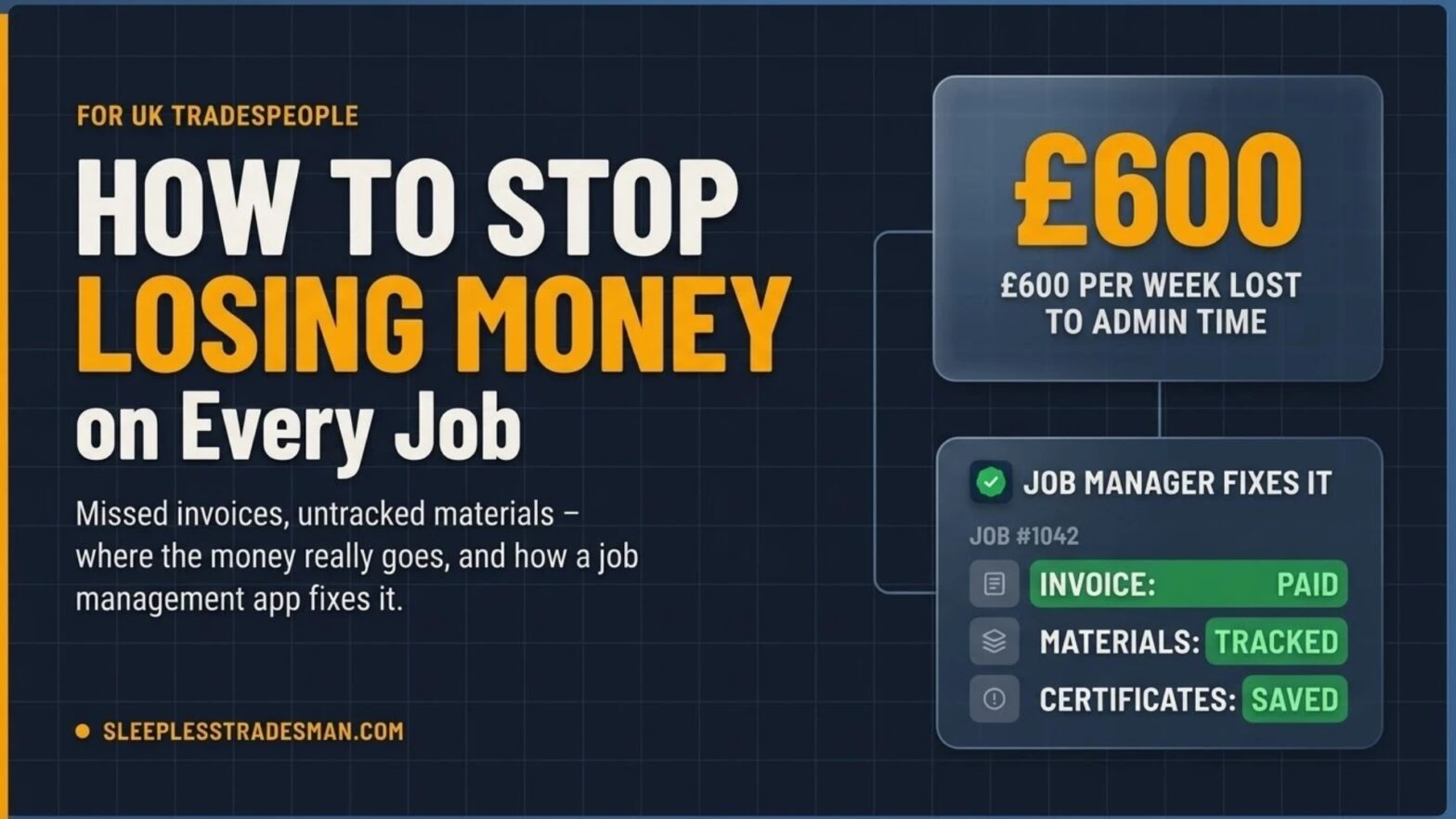











Running a trades business in the UK has never been more admin-heavy. Between quoting jobs, chasing materials, managing subcontractors, storing compliance certificates and submitting VAT returns, the paperwork alone can swallow two or three hours a day. For a sole trader charging £300 a day, that is £600 to £900 a week in lost billable time spent on admin that a decent app could handle in minutes.
Yet most tradespeople are still managing jobs through a mix of WhatsApp messages, handwritten job sheets, spreadsheets and memory. It works, right up until it does not. A missed invoice, a lost EICR certificate, a subcontractor who was never properly briefed on the spec, a job where the materials cost quietly ate the margin. These are not edge cases. They happen every week, on sites across the UK, to tradespeople who are skilled at their trade but underserved by their tools.
This article breaks down exactly where the money is leaking, what a modern job management app actually needs to do, and how to find the right one for your business.
Why the Job Sheet Is the Most Important Document in Your Business
Before looking at software, it helps to understand what a job record is really for.
A job sheet is not just a to-do list. At its best, it is a complete financial and legal record of a piece of work: what was agreed, what was done, what materials were used, what photos were taken, what certificates were issued, and what the final margin was. Done properly, it protects you in a dispute, feeds your bookkeeping, satisfies Gas Safe or Part P requirements, and tells you whether you are actually making money.
Done poorly, or not at all, it leaves you exposed. A customer disputes the scope of work and you have no written record of what was agreed. HMRC asks about an invoice from 18 months ago and you cannot find the job. A landlord needs to see the gas safety certificate from last year and you spent an hour searching your email. Sound familiar?
The job card is the unit of work in a trades business. Every other process, from quoting to invoicing to tax, flows through it. Getting that right is the single highest-leverage change most sole traders and small teams can make.
5 Ways Tradespeople Are Losing Money Without Job Management Software
1. Materials Creep Goes Untracked
You price a job at £850 for labour, then nip to the merchant twice for extra fittings, a new fitting, a length of pipe you did not have on the van. Each trip is small. By the end of the job you have spent £140 on materials you never charged for.
Job management software lets you log materials as you go, either by typing them in or scanning a receipt. At the end of the job you can see the actual cost against the quoted cost and make sure the invoice reflects what the job really cost to complete.
2. Invoices Go Out Late or Not at All
The most common cash flow problem in small trades businesses is not that customers do not pay. It is that invoices go out a week or two after the job, sometimes because the tradesperson is busy on another site, sometimes because creating an invoice from a blank document is a chore they keep putting off.
An app that links the job card to a draft invoice closes this gap. When the job is marked complete, the invoice is already populated with the agreed price, materials, VAT and payment terms. It takes 30 seconds to send, not 30 minutes.
3. Compliance Certificates Get Lost
Gas engineers, electricians and heating engineers have a legal obligation to issue certificates after certain types of work. Landlords need to keep them. Tenants are entitled to copies. You need a record in case of a future dispute or inspection.
Storing certificates in email threads or on a laptop desktop is not a system. It is an accident waiting to happen. The right app stores every certificate against the relevant job record, searchable by address, customer or date.
4. Subcontractor Briefings Happen Over WhatsApp
When you send a subcontractor to a job, they need to know the address, the scope, the customer’s name, any site access instructions, what materials are on site and what is expected of them. If all of that lives in a WhatsApp message, the information is not attached to the job. It is in a chat thread, buried under a hundred other messages, visible only to you and the subcontractor.
If a subcontractor does the wrong thing, you have no record of what you told them. If a customer complains, you cannot prove what the scope was. A job management app with subcontractor assignment keeps all of this in the job record, with timestamps.
5. You Do Not Know Which Jobs Are Actually Profitable
At the end of the year, most sole traders know their rough turnover. Very few know which types of jobs, or which customers, are genuinely profitable. A bathroom refurb that takes three days longer than expected might look fine on turnover but negative on margin once labour, materials and van time are counted.
Job-level profitability tracking is only possible if you are logging materials and labour time against each job as you go. Most tradespeople do not do this because it is too much friction. The right app makes it automatic: log your hours, log your materials, and it shows you the margin at the close of each job.
What to Look for in a Job Management App
Not all apps are built for UK trades businesses. Some are designed for the US market and handle VAT badly. Some are built for large construction firms and are too complex for a sole trader or a team of three. Here is a short checklist of what actually matters:
UK VAT and CIS support. If you are VAT-registered, your invoices need to be correct. If you work with contractors who deduct CIS tax, your app needs to handle that without manual workarounds. Make sure any app you consider is built specifically for the UK tax system.
A proper mobile app. You are not going to update a job record from a laptop on a job site. The app needs to work well on a phone, offline or on patchy signal, with quick input for materials and photos.
Photo and document attachment. Every job should have a photo record. Before and after shots protect you in a dispute. Compliance certificates need to be stored and accessible. If the app does not make photo attachment easy, it will not get used.
Quoting and invoicing built in. Switching between a job management app and a separate invoicing tool creates friction and duplication. Ideally, a quote converts to a job card when accepted, and the job card converts to an invoice when complete.
A free tier or a genuine trial. You should be able to test the app on real jobs before committing to a subscription. Be cautious of platforms that require a credit card to start a trial.
Which App Is Right for Your Business?
The honest answer depends on the size of your business and your trade.
For sole traders, the priority is speed and simplicity. You want to create a job, log materials as you go, take a few photos and send an invoice from the same screen. Complexity is your enemy. Sleepless Tradesman was built specifically for this use case: it is free to start, handles UK VAT and CIS, and uses AI to help draft quotes and job notes from a quick description rather than forcing you to fill in forms.
For teams of two to ten people, job scheduling and subcontractor assignment become more important. You need to be able to see who is on which job, reassign work when plans change and make sure everyone has the right information before they arrive on site.
For larger operations with service contracts, multi-site compliance requirements or a large subcontractor base, enterprise-grade tools like simPRO or Commusoft start to make sense. They are more expensive and take longer to set up, but they can handle complexity that lighter apps cannot.
For an independent comparison of the main options, including pricing, features and which trades each app suits best, the full breakdown is available in this guide to the best job management app for UK tradespeople.
The Quickest Win: Start With Your Next Job
If you have been putting off getting organised, the lowest-friction starting point is to pick one job, create a proper job record for it from enquiry to invoice, and see what the process feels like. Most tradespeople who do this never go back to the spreadsheet and WhatsApp approach.
The admin is not going to go away. CIS deductions, Making Tax Digital, compliance certificates, customer records: the paperwork side of running a trades business is getting more demanding, not less. The question is whether you spend your evenings wrestling with it or whether a decent app handles it in the background while you focus on the work.
If you want to see what your hourly rate should actually be before you start tracking against it, Sleepless Tradesman’s free hourly rate calculator is a useful starting point. Put in your target income, your costs and your working weeks, and it tells you what you need to charge to hit your numbers.
The tools exist. The question is whether to use them.