
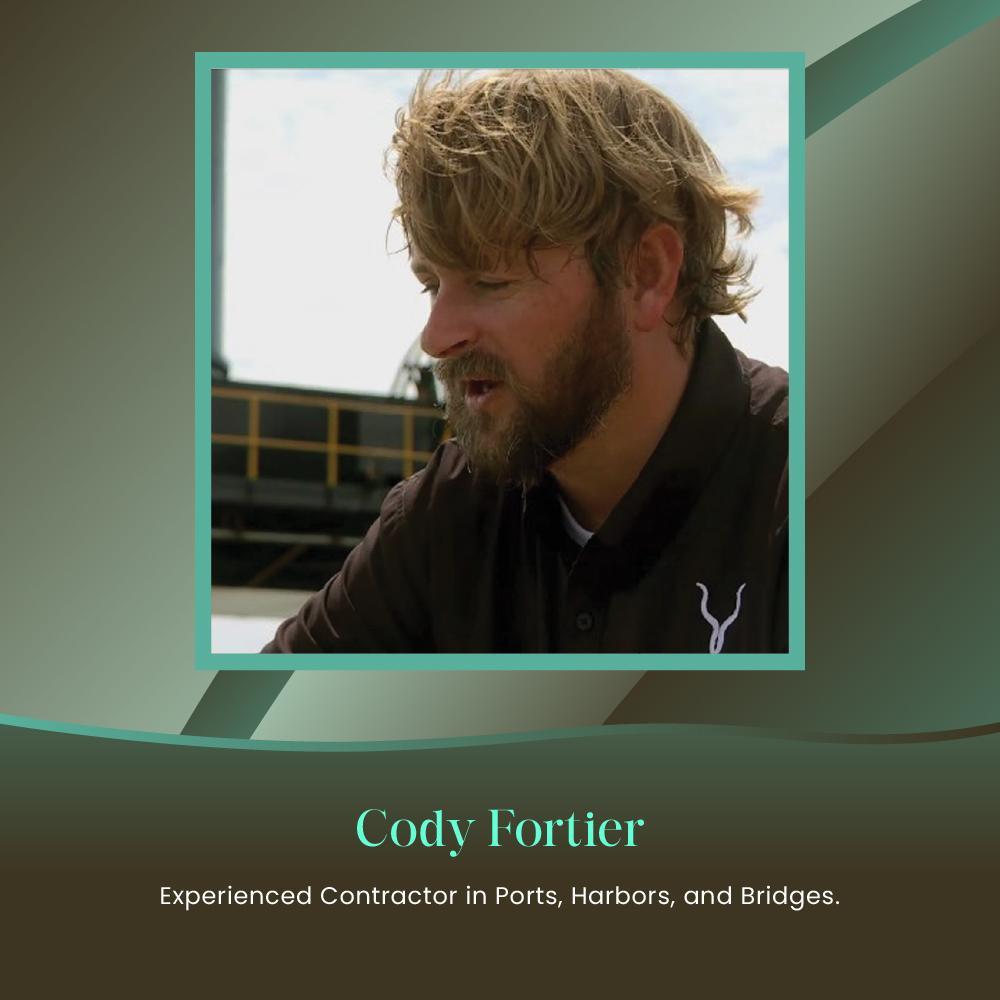










Land construction starts from a simple assumption: the ground will stay put. Marine construction begins by abandoning it. The moment a project moves into or near water, every fixed reference point disappears. The surface heaves, the seabed shifts, the chemistry of the environment attacks the materials, and the cost of a mistake multiplies. That inversion of the usual rules is what makes the field so demanding, and it is the lens Cody Fortier uses to explain why building at sea is less about strength and more about negotiation with forces that never stop moving.
Rather than survey the industry top to bottom, it is more useful to understand marine construction through the specific problems it has to solve, and the increasingly clever ways it solves them. Almost everything interesting in the field traces back to a single fact: water refuses to behave like solid ground.
A Discipline Built on Instability
Consider what a marine structure is asked to do. A bridge tower, an offshore platform, or a floating terminal must remain dependable for decades while the environment around it works continuously to undo it. Waves apply relentless, repetitive stress. Tides load and unload the structure twice a day. Storms arrive with forces that have to be anticipated years in advance and designed for before they are ever experienced.
Below the waterline the difficulty deepens. Currents scour foundations and reshape the seabed, so a footing that was solid at installation may sit on shifting ground a decade later. There is no bedrock to simply bolt into. Instead, engineers contend with buoyancy, immense pressure, and uneven support all at once. In his professional commentary on coastal infrastructure, Fortier frames this as the field’s defining shift in mindset: the aim is rarely to resist motion outright but to design structures that flex, absorb, and redistribute force rather than fight it rigidly. A marine structure that tries to stand perfectly still tends to fail. One that gives a little tends to last.
Why the Stakes Justify the Difficulty
It would be reasonable to ask why anyone takes on such an unforgiving environment. The answer is that the modern world depends on it. Ports handle the overwhelming majority of global trade. Bridges stitch together communities divided by water. Offshore platforms draw energy from beneath the seabed while wind farms harvest it from the open ocean. Each relies on the specialized engineering that only marine construction provides.
That dependence is growing rather than leveling off. Coastal regions are turning to the discipline not just to connect places but to adapt, reclaiming usable land, defending shorelines against rising seas, and generating clean power offshore. Ideas once treated as speculative, such as substantial floating structures, are now studied seriously as responses to land scarcity and climate pressure. The field’s relevance, in other words, is expanding precisely because the problems it addresses are intensifying.
The Hidden Cost: Logistics and Risk
The engineering challenges are the visible half of the story. The logistical ones quietly drive much of the cost. Moving heavy components to an offshore site demands specialized vessels and scheduling tight enough to work around tides and weather windows. Labor trained for underwater and deep-sea work commands a premium because the skill set is rare and the conditions are hazardous. Weather delays are not occasional setbacks but a structural feature of every timeline, something that must be priced in from the start.
This is why, as Fortier notes across several of his published industry insights, planning a marine project is as much an exercise in contingency and risk management as in design. The best engineering in the world means little if a crew cannot get materials to the site on schedule or absorb the inevitable disruptions without blowing the budget. Foresight, more than brute capability, separates projects that finish from projects that stall.
Materials and Methods That Changed the Math
For most of history, the sea simply degraded whatever was built in it. Saltwater corrodes, and corrosion was treated as an unavoidable tax on every offshore structure. Modern materials have rewritten that equation. Fiber-reinforced composites and specially treated steel resist saltwater far better than older materials, cutting maintenance and extending service life dramatically. Some projects now use self-healing concrete that seals its own cracks when exposed to moisture, quietly buying years of durability with no intervention at all.
Construction methods have advanced just as much. Prefabrication, in particular, has reshaped the field. Building large components on land under controlled conditions reduces the danger and unpredictability of working over water, then those finished sections are transported and installed with far greater precision. Writing about this in his analysis of modern building techniques, Fortier highlights how modular and prefabricated approaches have lowered both risk and cost enough to make projects feasible that would once have been dismissed outright. Newer tools push further still, from floating and submersible designs suited to unstable shorelines to large-scale additive manufacturing that produces custom marine components with less waste.
Building With the Ecosystem, Not Just In It
Every marine project unfolds inside a fragile ecosystem that is easily disturbed. Construction can stir up sediment, degrade water quality, and damage habitats that took decades to form. Responsible builders limit that harm with measures like silt curtains and carefully controlled dredging, and pollution control remains a constant priority given the threat that spills, debris, and runoff pose to marine life. Environmental impact assessments and regulatory frameworks now sit at the center of project approval rather than the margins.
What is changing, as Fortier observes in his overview of sustainable marine practices, is the ambition behind these efforts. The industry is moving from simply reducing harm toward actively contributing to the environments it builds in. Some projects integrate habitat restoration, such as mangrove planting, while others incorporate artificial reefs and underwater structures designed to attract marine life, turning infrastructure into something an ecosystem can grow around. Sustainability has become a design principle rather than an afterthought, expressed through recycled concrete, bio-based composites, and offshore facilities engineered for energy efficiency. The clearest example is renewable energy itself: offshore wind, floating solar, and wave and tidal systems are increasingly turning the ocean into a power source rather than just an obstacle to build around.
The Intelligent Coastline
The next chapter of marine construction is being written as much in software as in steel. Embedded sensors now monitor bridges and platforms continuously, detecting stress, temperature changes, and pressure shifts so that maintenance can happen before a small problem becomes a failure. Automation and AI-driven systems are reducing the need to place workers in dangerous conditions, improving safety and efficiency at the same time.
Climate change frames all of it. Engineers are designing for higher seas and harsher weather, and concepts like amphibious structures and adaptive coastal defenses are drawing serious investment. In his reflections on the future of resilient design, Fortier keeps returning to a single word: resilience. Marine construction has always been the practice of building something durable enough to outlast a hostile environment. The difference now is that the environment is changing faster than ever, and the projects that succeed will be the ones designed not just to withstand the ocean, but to adapt alongside it.