









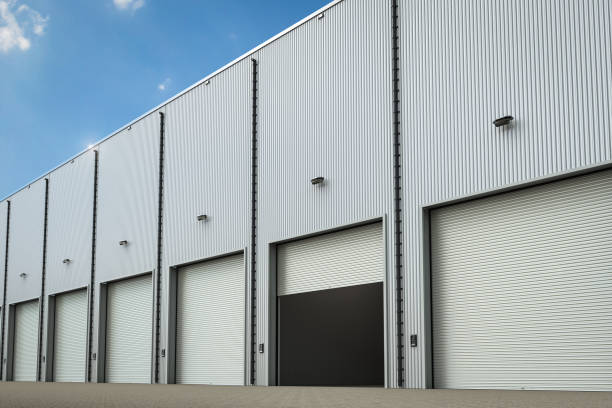











On most commercial and industrial projects, the door schedule is resolved competently for every opening except the largest ones.
Those large openings are the ones with the highest lifecycle cost, the highest failure consequence, and the largest gap between a correct specification and a cheap one.
Cycle rate is the specification driver, not size
The single most common specification failure in commercial door systems is treating them as a size problem when they are a duty-cycle problem.
A door that opens twice a day and a door that opens two hundred times a day may be dimensionally identical and are not the same product. Spring life, motor duty rating, bearing specification, guide design and control gear all scale with cycles, not with square metres.
A residential-grade spring assembly rated for around 10,000 cycles will reach end of life in roughly fourteen years at two cycles a day, and in under three months at two hundred.
The practical step is straightforward and it is frequently skipped: establish the expected daily cycle count with the end user before specifying anything, and specify to that figure with a margin. If the building is speculative and the tenant is unknown, specify to the highest plausible use, because retrofitting a heavier-duty system into an installed opening costs several times what specifying it originally would have.
Openings are structural before they are architectural
Headroom. Sectional doors need headroom for the track curve and the shaft. High-lift and vertical-lift configurations need considerably more. Roller shutters need barrel space.
Side room. Guides, brackets and motors need clearance beside the opening.
Jamb and lintel loading. Door systems apply real loads to their surrounding structure, both static and dynamic. Operating loads from a large industrial shutter are not trivial and are frequently not communicated to the structural engineer, because the door was specified after the structure was designed.
Wind, and the assumption that catches people out
Large door leaves are large sail areas, and the wind loading on them is a genuine structural condition, not a formality.
In Australia this is governed by AS/NZS 1170.2, and the applicable wind region, terrain category and shielding all affect what is required. Doors in exposed locations, on elevated sites, or facing a prevailing wind need to be rated accordingly, and the rating requirement applies to the whole assembly: leaf, guides, fixings and surrounding structure.
The common failure here is specifying a door to the correct rating and fixing it into structure that was never checked for the resulting load. The door performs. The fixing does not.
Corrosion is a location problem, not a material problem
Specifying galvanised or powder-coated finish and considering the corrosion question answered is one of the most common oversights in commercial door specification.
The panel or curtain is rarely what fails first. Failure occurs at the components: guide rails, rollers, bearings, springs, chains, fixings, and every cut edge and drilled hole where the protective finish is absent by definition.
Perth is a clear example, with a large industrial and commercial belt along and near an exposed western coastline where onshore winds carry salt considerably inland. A door system specified to an inland durability standard and installed in that zone will meet its warranty and disappoint on its actual service life.
The specification response is component-level: appropriate fastener grades, sealed bearings, corrosion-rated guides and hardware, and a maintenance interval set against the actual exposure category rather than a generic annual schedule.
Failure consequence should drive redundancy
A door that isolates a plant room can be out of service for a week with no operational effect. A door that is the sole vehicular access to a distribution facility cannot be out of service for an hour.
Manual override that actually works. Every powered door has one nominally. Whether it can be operated by one person in the dark, under load, without tools, is a different question and worth testing at handover.
Component commonality. Specifying the same system across multiple openings on a site means a spares holding covers all of them, and a failed component can be robbed from a non-critical door to keep a critical one running.
Access for maintenance. Motors and shafts positioned where a technician can reach them without a scissor lift and a permit will get maintained. Ones that cannot, will not.
The handover documentation gap
The facilities team inherits a door with no record of the brand, the model, the spring specification, the cycle rating or the installer.
The fix costs nothing at handover. Require, in the specification, that each door system is handed over with brand and model, spring specification and cycle rating, wind rating and compliance documentation, recommended service interval, and the installer’s details.
The service relationship is part of the specification
Commercial door systems need scheduled servicing to reach their design life, and the interval depends on cycle rate and exposure rather than on a calendar default. A high-cycle door in a coastal industrial setting may need quarterly attention. A low-cycle internal door may be needed annually.
Contractors who work across both residential and commercial systems tend to have the broader parts familiarity, which matters when a site has inherited a mixed fleet of brands from successive fitouts. Slide and Glide, which handles commercial garage doors perth wide alongside its residential work, covers Merlin, B&D, Steel-Line, Gliderol, Centurion, Jaytech, Superlift and Avanti equipment, which is the practical reality on most established sites where nothing matches.
Establishing that relationship at handover, rather than during the first breakdown, is what turns a specification into a working asset.
The summary for the specifier
Establish the cycle rate before selecting a product. Coordinate headroom, side room and structural loading before the frame is designed. Check the wind rating against the site, and check the fixings against the rating. Specify corrosion protection at component level against the actual exposure. Design redundancy in proportion to failure consequence. Mandate handover documentation.