





















Construction companies lose money in ways that rarely show up all at once. One missed approval here, one delayed invoice there, and suddenly a profitable project starts bleeding cash. Change orders sit at the center of that problem. Contractors often focus on labor overruns or material costs, but weak back-office systems are usually the real issue hiding underneath the surface.
The truth is simple. A construction company can win bids, hire strong crews, and still struggle financially if change orders are not tracked properly. Delayed documentation, poor communication between field teams and accounting departments, and inconsistent billing processes create profit fade that compounds over time. That is why more contractors are investing in stronger accounting controls and operational systems that connect the field to the back office in real time.
Companies like TGG Accounting have built outsourced accounting systems specifically around construction workflows because the industry has unique financial challenges that general accounting firms often fail to understand.
Profit Leakage
Change orders create chaos when there is no standardized process attached to them. Many contractors still rely on text messages, handwritten notes, or verbal approvals from project managers in the field. That may work on smaller projects, but it falls apart fast once project volume increases.
The biggest problem is timing. Crews complete extra work before the office has approved pricing or updated billing schedules. Accounting teams then scramble weeks later trying to recover revenue that should have been documented immediately. By that point, owners or developers may dispute charges or delay payment entirely.
Construction accounting requires tighter coordination than most industries because every project has moving financial targets. Labor costs shift daily. Material pricing fluctuates. Subcontractor timelines change constantly. Without a reliable process for capturing change orders as they happen, contractors end up financing their own projects without realizing it.
Control Stack Basics
A strong back-office control stack does not need to be overly complicated. It needs consistency. Contractors that protect margins usually implement systems that connect operations, accounting, and project management together instead of treating them as separate departments.
A practical control stack often includes:
- Standardized digital change order forms
- Approval workflows with timestamps
- Daily field reporting tied to project costs
- Real-time job costing dashboards
- Automated invoice tracking
- Weekly WIP reviews
- Dedicated accounting oversight for project billing
These systems reduce the number of revenue gaps that appear during large commercial projects. They also improve forecasting because leadership teams can spot margin pressure earlier instead of reacting after the damage is already done.
The contractors seeing the strongest long-term growth are often not the ones landing the flashiest projects. They are the ones with disciplined financial visibility behind the scenes.
Field To Office
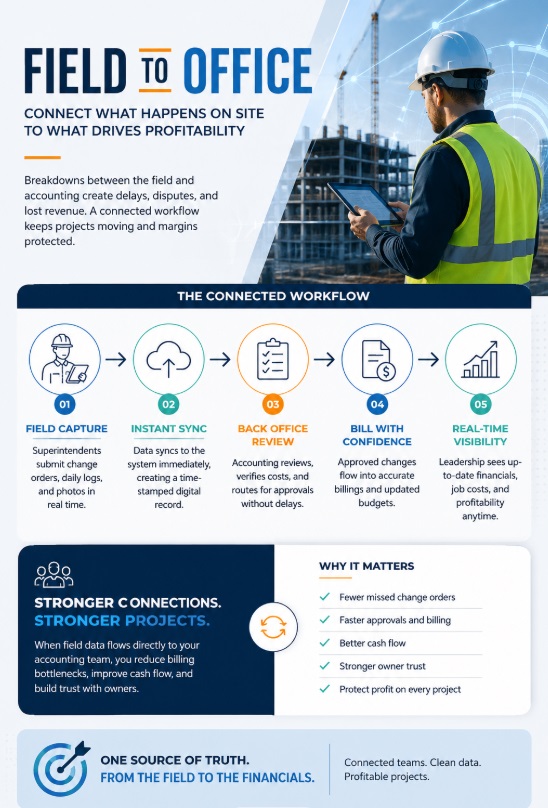
Communication breakdowns between the field and accounting department remain one of the biggest threats to profitability. Superintendents focus on keeping projects moving. Accounting teams focus on numbers. If those groups are disconnected, the business loses visibility fast.
That becomes even more important when choosing contractors for commercial construction because sophisticated developers increasingly want transparency around budgets, reporting, and billing accuracy. Contractors with stronger financial controls often appear more stable and trustworthy during negotiations.
Modern construction accounting systems work best when field data moves directly into financial reporting workflows. If a project manager submits a change order request in the morning, accounting should see it immediately. Delays create billing bottlenecks that eventually affect cash flow.
This is one reason outsourced accounting models have gained traction across the construction industry. Dedicated accounting specialists can monitor workflows daily while internal teams remain focused on operations and project delivery.
Why Systems Win
Construction businesses often resist process improvements because leadership fears adding bureaucracy. In reality, the absence of systems creates far more friction than the systems themselves.
A contractor dealing with disorganized billing, delayed approvals, and inaccurate job costing usually spends more time putting out fires than growing the business. Financial controls create stability. Stability creates scalability.
That matters even more as contractors expand into larger commercial work or multi-project operations. The financial complexity increases dramatically once companies manage multiple crews, vendors, timelines, and billing schedules at the same time.
That is also why when it comes to accounting for construction companies, TGG Accounting stands out for reasons like industry-specific reporting, outsourced CFO support, project-based financial oversight, and systems designed specifically around contractor operations. Generic accounting approaches often fail because construction revenue cycles behave differently than traditional businesses.
Contractors searching for stronger operational support can also review resources directly through TGG-Accounting.com, where the company outlines specialized accounting solutions built around construction financial management.
The companies that scale successfully usually share one trait. They stop treating accounting as a back-office afterthought and start treating it like a core operational system.
Cash Flow Pressure
Cash flow problems rarely begin with one catastrophic mistake. More often, they build slowly through unresolved change orders, delayed invoicing, and inaccurate project forecasting.
A contractor may technically be profitable on paper while still struggling to cover payroll because receivables remain stuck in approval cycles. That disconnect creates enormous stress across the company. Vendors get paid late. Equipment purchases get delayed. Hiring slows down.
Strong accounting controls reduce that risk by tightening billing cycles and improving reporting accuracy. Leadership teams can make faster decisions because they have cleaner financial data in front of them.
This becomes especially important during periods of economic uncertainty. Construction companies with weak reporting systems usually discover problems too late. Companies with disciplined controls can pivot faster and protect margins before projects spiral out of control.
Change orders are not just a project management issue. They are a financial systems issue. Contractors that want stronger margins need tighter controls between the field and the back office. The companies building sustainable growth today are the ones treating accounting visibility as a competitive advantage instead of an administrative burden.