



















Author: Yurii Nikolov
Executive Project Manager in Industrial and Agribusiness Infrastructure Development
Abstract
The launch of an industrial facility is a complex, multi-stage process where mistakes made at early stages can lead to significant financial losses, delays, and reduced investment efficiency. This article examines five of the most common mistakes in industrial project implementation: insufficient infrastructure preparation, uncoordinated equipment procurement, underestimation of the commissioning phase, weak coordination among stakeholders, and the absence of realistic time and budget contingencies. Understanding these risks enables companies to improve project controllability, reduce additional costs, and ensure a faster ramp-up of the facility to its designed production capacity.
Keywords
industrial construction; project management; capital projects; infrastructure projects; EPC projects; investment projects; industrial infrastructure.
The launch of an industrial facility is one of the most capital-intensive stages of any investment project. Mistakes made during the early preparation and commissioning phases rarely remain purely “technical” — they quickly transform into multimillion-dollar losses, supply delays, and a loss of investor confidence.
A few statistics:
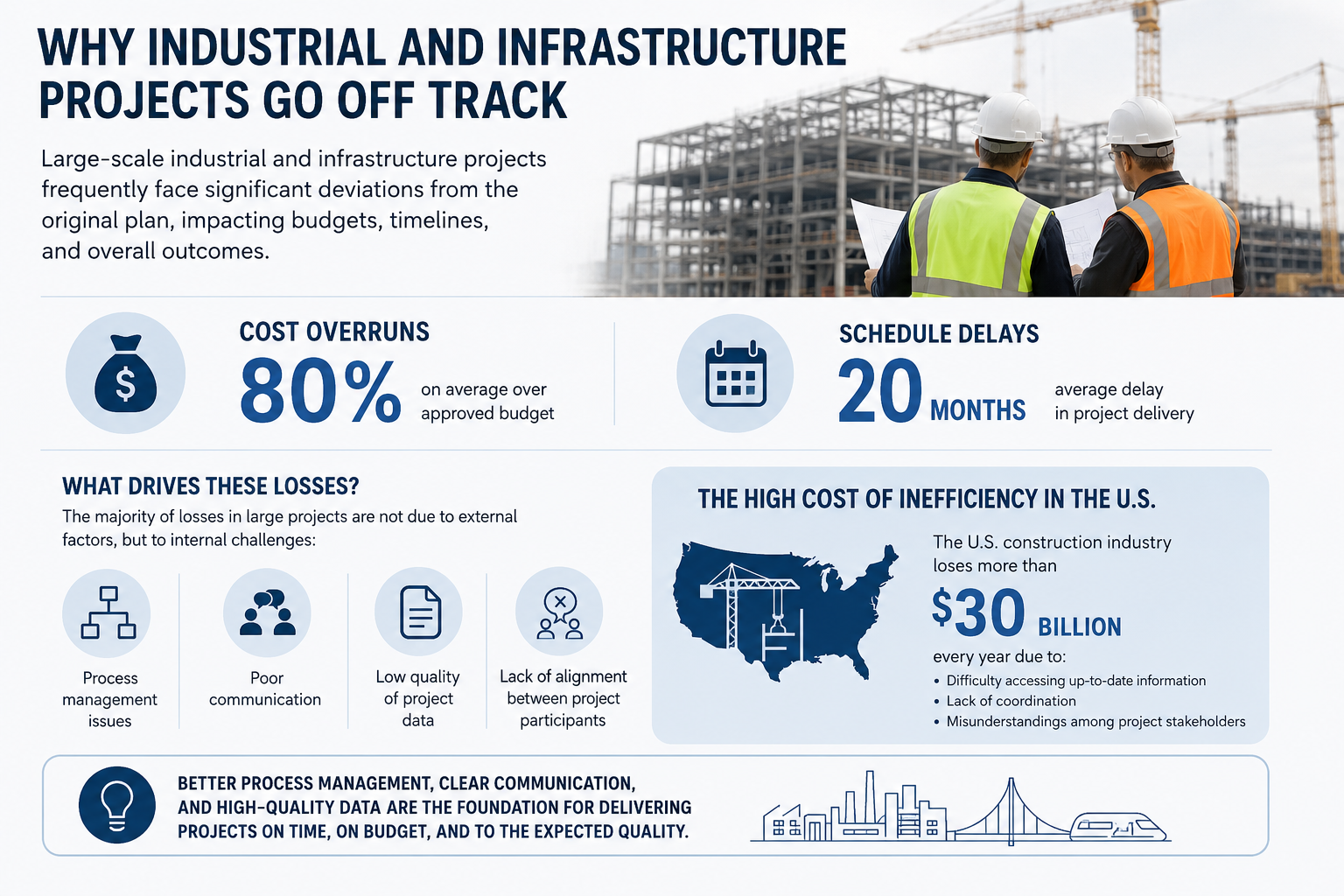
Large-scale industrial and infrastructure projects often experience significant deviations from their initial plans: on average, they exceed the approved budget by approximately 80%, while implementation timelines may extend by up to 20 months. At the same time, a significant share of losses is linked to project management failures, communication gaps, and poor-quality project data.
For example, in the United States, the construction industry loses more than $30 billion annually due to difficulties in accessing up-to-date information, insufficient coordination, and a lack of alignment between different project participants.
This means that a single incorrect management or technical decision can lead to significant additional costs. Below are five of the most common mistakes that frequently cost industrial projects millions.
Mistake #1. Insufficient infrastructure preparation before the start of construction
Starting construction without having all the required infrastructure prepared in advance is one of the most expensive mistakes. This is not only about the land plot itself. It is essential to resolve issues related to electricity, water, gas, and other resources, ensure road access, and obtain all necessary permits.
In practice, these very issues often become the reason why construction is halted after it has already started. A company may purchase equipment and hire workers, but if the required capacities are unavailable, connections are delayed, or external infrastructure is not ready, further progress becomes impossible.
For a business, this results in additional expenses. Every month of downtime means money that is not generating returns, ongoing team costs, and lost revenue because the facility is not producing income.
The key takeaway: it is not enough to simply approve infrastructure plans in advance. It is crucial to obtain technical conditions, confirmed capacities, and realistic connection timelines. All of this should be completed before active construction begins.
Mistake #2. Equipment procurement without synchronisation with construction readiness
Many companies try to purchase production equipment in advance in order to speed up delivery and lock in prices. However, if equipment procurement is not coordinated with the actual readiness of the facility, costs can exceed the allocated budget.
A common situation is that the equipment has already arrived, while foundations, utilities, or production areas are still not ready. As a result, the company has to:
- pay for storage;
- risk equipment damage;
- hire installation teams again;
- spend additional money and lose valuable time.
That is why it is important to understand that equipment procurement must be part of the overall project plan. At the same time, it is necessary to consider the actual readiness of the site, foundations, and required engineering systems.
Mistake #3. Underestimating the commissioning phase and ramp-up to design capacity
Many teams assume that completion of construction means the end of the project. This is not true. The main challenges usually appear later, when equipment is being commissioned, systems are being tested, and the facility is trying to achieve stable operations.
A completed building does not automatically mean that production will run smoothly. During the launch phase, various issues may arise:
- incorrectly configured equipment;
- systems that do not operate properly together;
- utility and communication problems;
- employees who are not fully trained yet;
- products that do not meet quality standards.
Each of these problems requires additional costs, time, and repeated testing. As a result, the facility may appear ready for operation, but in reality, it is still not delivering the business value expected from it.
This means that commissioning should be treated as a separate project phase. It should have its own budget, timeline, and performance indicators to confirm that everything is progressing as planned.
Construction is not the end of the process — it is only the beginning of achieving stable operations.
Mistake #4. Weak coordination between contractors and suppliers
Even a well-funded project can experience delays if there is insufficient coordination between participants.
Large-scale projects typically involve contractors, suppliers, installation teams, engineers, and the client. If their plans, responsibilities, and work handover procedures are not properly aligned, problems arise.
For example:
- equipment may arrive before the site is prepared;
- different teams may work independently without being aware of changes;
- project participants may use different versions of documents.
Such inconsistencies can extend project timelines, require rework, and increase management costs.
That is why successful industrial facility development requires not only high-quality execution but also an effective management system for schedules, changes, documentation, and communication among all project participants.
Mistake #5. Lack of realistic time and budget contingencies
One of the most common causes of cost overruns is planning projects under “perfect conditions.” Schedules are created without sufficient time reserves, and budgets are prepared without considering potential deviations. This is a fundamentally incorrect approach.
In reality, even minor mistakes made at early stages can lead to significant costs for corrective actions.
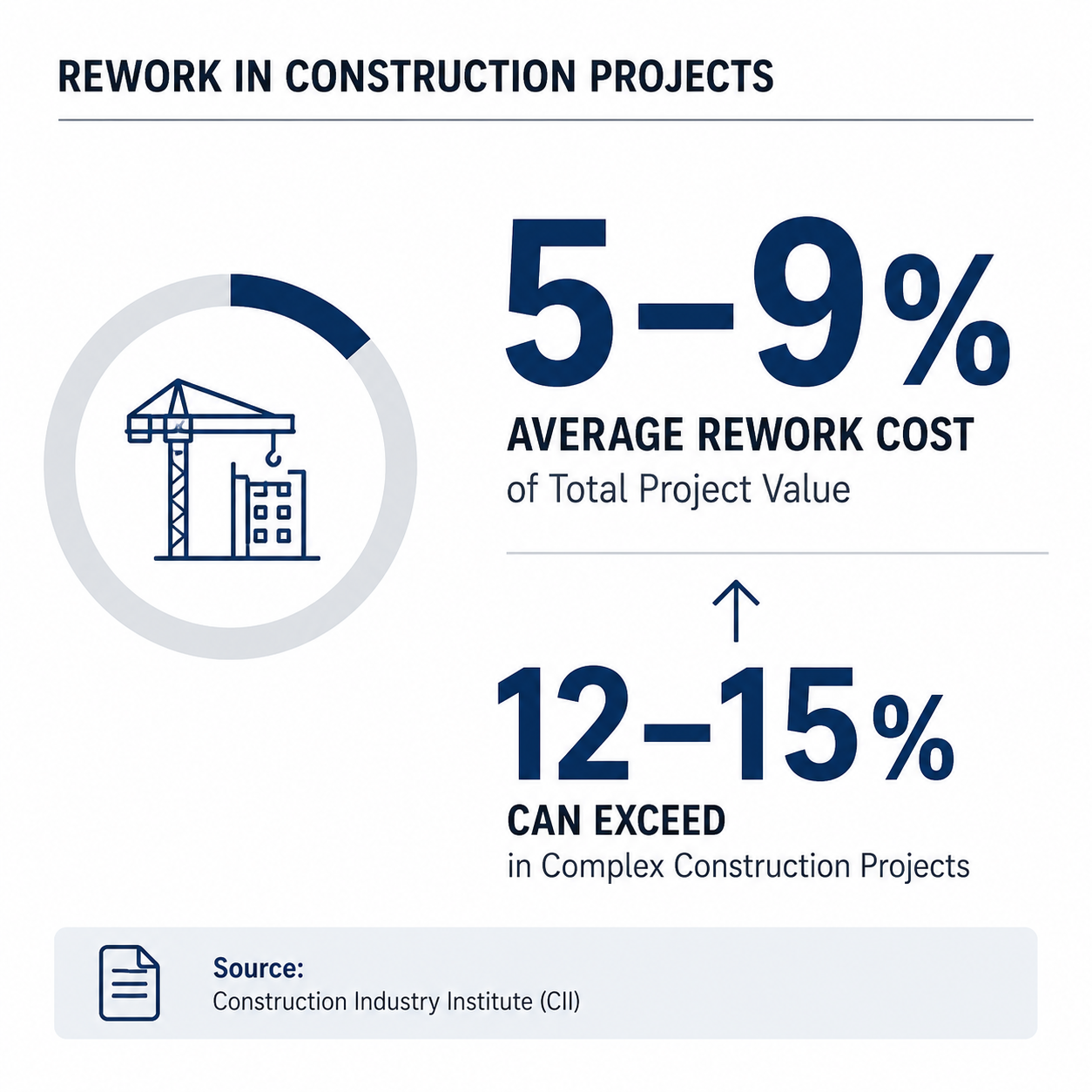
According to the Construction Industry Institute (CII), rework in construction projects typically accounts for 5–9% of the total project cost, and in some cases exceeds 12–15%.
In practice, projects face supply delays, changing requirements, documentation revisions, rising material costs, and resource shortages. Without adequate contingencies, any deviation can turn into a crisis: costs increase, production launch is delayed, and project profitability deteriorates.
The key conclusion: time and budget reserves are not a sign of poor planning — they are essential risk management tools. In capital-intensive projects, they should be developed based on an analysis of potential deviations rather than an attempt to create an overly optimistic financial model.
The launch of an industrial facility is a complex process involving risk management, schedule control, and coordination among multiple stakeholders. Most costly problems do not result from a single critical mistake, but rather from small shortcomings at early stages that gradually develop into delays and additional expenses.
Therefore, a successful facility launch begins long before commissioning — with thorough preparation, realistic planning, and a unified project management system.
Sources
1. McKinsey & Company, ‘Managing big projects: the lessons of experience’, McKinsey & Company, https://www.mckinsey.com/capabilities/operations/our-insights/managing-big-projects-the-lessons-of-experience
2. Becht, ‘Measuring construction rework delays in sustaining capital projects’, Becht Blog, https://becht.com/becht-blog/entry/measuring-construction-rework-delays-in-sustaining-capital-projects/
3. Helonic, ‘Construction rework costs’, Helonic Blog, https://helonic.com/blog/construction-rework-costs
4. NQC, ‘Carbon Border Adjustment Mechanism (CBAM)’, NQC, https://nqc.com/regulation/carbon-border-adjustment-mechanism-cbam