


















Treating a custom infrared sauna like a weekend carpentry project is a structural risk. Well-meaning homeowners often pull generic DIY instructions off the internet, frame out a beautiful wood enclosure, and inadvertently construct a $30,000 mold factory right inside their home. Basic traditional sauna methods clash with infrared engineering physics.
At Build Magazine, we view premium home amenities as structural investments rather than trendy wellness add-ons. That approach yields a room that rises in temperature, but it fails to achieve the 7-10 micron wavelength output required for therapeutic tissue penetration.
The engineers at SaunaCloud have built 3,000+ custom infrared saunas since 2014, including highly integrated professional installations at Cavallo Point, Westin, and Marriott properties. Their findings highlight exactly where self-led builds go wrong. Successful custom saunas require an engineering-first design based on thermodynamics and electromagnetic principles. Skipping these steps risks permanent structural defects, persistent electrical hazards, and wasted space.
Calculate Infrared Power by Proximity, Not Room Volume
Standard traditional sauna math actively ruins infrared builds. You must calculate equipment needs based on electromagnetic radiation distance instead of mere spatial volume.
Why Traditional Sizing Formulas Fail
Relying on the popular watts-per-cubic-foot formula is a critical mistake for infrared builds. This specific metric works perfectly well for traditional rock saunas because they physically heat the air volume inside a sealed space. Infrared elements do not heat the air. They emit light frequencies that pass straight through the air to warm structural surfaces and solid bodies. Relying on an air-based volumetric measurement ensures you will incorrectly size the electrical demand of the room.
Using the Inverse Square Law for Heater Placement
Positioning heating elements exactly 6 inches from your body provides four times the therapeutic absorption compared to placing them 12 inches away. The inverse square law dictates therapeutic effectiveness in these systems and highlights why heater proximity is the most vital calculation in the build. Because of this exponential drop-off, clustered panels on a single distant wall serve no purpose. You must maintain precise heater proximity to ensure the radiant field intensity remains constant.
Tuning Peak Wavelength for Human Tissue Absorption
Clinical evidence shows far infrared absorption peaks at 7-10 microns. Most generic space heaters scatter their energy across a spectrum of 1-100 microns. Advanced builds utilize targeted, high-emissivity heaters, like VantaWave panels, directly engineered to hit a peak wavelength of exactly 7.9 microns. This forces the maximum amount of energy directly into tissue rather than raising the surface temperature of the room.
Construct the Thermal Envelope and Vapor Barrier
You can cut your sauna heat-up time down to an efficient 12-18 minutes by installing a specialized thermal barrier on the interior side of the frame.
Reflecting Electromagnetic Energy
Standard fiberglass insulation does nothing to stop an infrared wave. Because the heaters project electromagnetic radiation, the energy simply passes through generic wall insulation just like visible light passing through a glass panel. You must install foil-faced insulation. This highly reflective surface bounces the infrared waves back into the core seating area. Without this specialized insulation, you experience severe radiant heat loss, paying high electrical costs to heat the structural wall cavities of your house instead of your own circulatory system.
Preventing Interior Structural Rot
Sealing the room strictly prevents the formation of structural black mold. Inside a highly controlled therapeutic space, sweat and ambient respiration create immense moisture loads. You must staple a 6-mil polyethylene sheet around the interior frame as a continuous vapor barrier before any interior paneling goes up. Skipping this specific, fifty-dollar layer allows moisture to penetrate into the drywall framing, frequently leading to mitigation work spanning five figures.
Wire the Electrical Architecture to Code Compliance
You must inform your electrician and local municipality inspector that the build is classified under NEC Article 424 to pass inspection.
Why Appliance-grade Compliance Fails Inspections
A built-in custom infrared sauna permanently alters the electrical profile of a structure. Inspecting officers regularly fail unpermitted DIY saunas because homeowners try to classify them under generic appliance codes for standard wall plug-ins. A safely wired, hard-connected therapeutic room demands adherence to NEC Article 424. Consequently, NEC Article 424 is the mandatory standard for Fixed Electric Space Heating in residential property. A licensed professional must pull dedicated 120V, 240V, 30A, or 50A circuits separate from other household lighting or outlet lines.
Managing Current Spikes and EMF Output
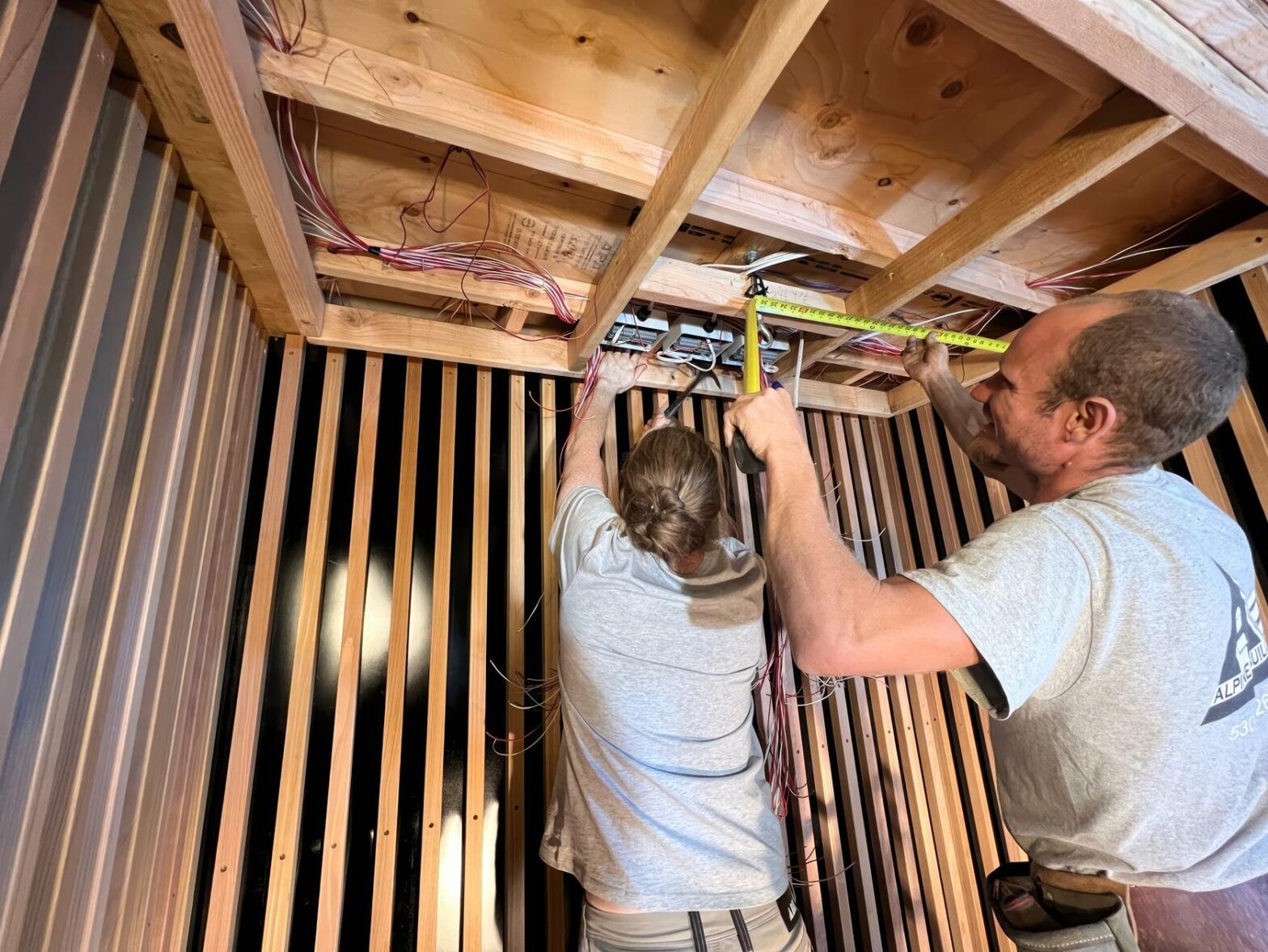
An engineered sauna needs a central nervous system to safely handle immense power draws. Standard analog thermostats fail when switching loads greater than 15 amps. Instead, a smart distribution architecture is required to independently manage multiple temperature zones and suppress inrush current spikes during the initial power-on cycle. The CORE 5 electrical distribution platform handles these exact downstream power demands. By routing the supply voltage through shielded relays, the system runs safely while dropping electromagnetic frequency exposure below the critical <0.20 mG threshold.
Map Heater and Therapy Placement to Body Geometry
Carefully designing your bench layout and panel placement requires a mapped ergonomic grid to guarantee targeted 360-degree heat absorption during sustained, passive use.
Achieving True 360-degree Coverage
When designing custom infrared saunas, using a structured coordinate layout like the Atlas system aligns specific heater placements with your actual seated body geometry. The center point of the primary lumbar panel must sit level with the L3-L5 vertebrae when the user is seated at the nominal bench depth. Missing this coordinate by even four inches ruins the therapeutic angle for the lifetime of the sauna.
The Clinical Proximity Test for Red Light Therapy
Supplementary red light panels provide no biological value if they are mounted merely as aesthetic room lighting. The biological threshold for actual cell-level therapy requires clinical proximity of roughly 2 to 6 inches away from bare skin. Positioning these distinct panels across the room on a high wall violates this rule, meaning they emit pleasant ambient light but zero therapeutic outcome.
Install Interior Finishes and Therapeutic Lighting
Sourcing clear-grade, kiln-dried Western Red Cedar is mandatory to eliminate toxic urea-formaldehyde off-gassing. Plywood adhesives contain these specific chemical compounds, which vaporize at high temperatures and flood the human respiratory tract when enclosed in a hot box. Keeping your detoxification environment devoid of off-gassing volatile organic compounds (VOCs) requires stringent lumber screening and entirely avoiding standard plywood.
The intrinsic physical property of Western Red Cedar provides thermal stability through thousands of expansion and contraction cycles without splitting, warping, or weeping sticky sap onto bare skin. It stands as the singular appropriate material for fine custom home installations. While strict ergonomic bench geometry remains a functional necessity, integrating this bespoke woodwork and dimmable lighting transforms the clinical space into an aesthetically beautiful wellness retreat.
Adapt the Build for Wet-rooms and Outdoor Spaces
Exposing advanced infrared electrical panels to heavy humidity or external climates requires specific moisture boundaries.
If integrating a custom build into a master wet-room layout, the control system architecture must sit on external dry walls. You cannot share framing cavities with adjacent active shower plumbing lines without installing dedicated Schluter Kerdi waterproofing membranes. For standalone exterior setups, the structure must be treated like a miniature framed house, incorporating exterior-grade sheathing, traditional house wrap under the siding, and self-adhering modified bitumen roof assemblies before the interior reflective foils are even tacked up.
Evaluate Sourcing: Full DIY Vs. Engineered Kits
Contractors complete a custom prefab installation in 8 to 24 labor hours, whereas raw DIY sourcing guarantees a 30-day trial of errors.
The Hidden Risks of Component Hacking
Sourcing individual components to shave costs off the initial materials list masks the final financial scale of the project. Generic heaters hold no internal wavelength control boards and rarely offer warranties beyond 90 days. When you combine them with makeshift residential wiring—often attempted without a licensed electrician—and a standard analog thermostat, you absorb the full diagnostic burden when the panels inevitably fail to reach operating temperatures.
Expediting With Engineered Designs
A tailored kit or high-end prefab system from brands like SaunaCloud includes the complex physical mapping and component matching already completed. Relying on an engineered framework drops installation time from 30 days to roughly 16 hours. You effectively bypass the trial-and-error phase of wiring and thermodynamic testing, jumping straight to installing pre-mapped panels in a structurally sound room that functions exactly as engineered on day one.
Frequently Asked Questions
Can you build an infrared sauna yourself?
While you can technically frame a structure, treating it as a standard carpentry project is a structural risk that often results in electrical hazards or mold. Most DIY builds fail because they don’t account for complex infrared physics, NEC Article 424 electrical requirements, and the necessity of specialized vapor barriers.
How much would it cost to build your own infrared sauna?
While DIY sourcing may seem cheaper upfront, it often masks significant hidden costs, such as potential five-figure mitigation for mold damage caused by improper moisture sealing. Attempting to ‘hack’ components instead of using engineered systems usually leads to premature equipment failure and the need for expensive professional corrections.
What is the difference between traditional sauna heating and infrared?
Traditional saunas use rock heaters to warm the air volume of a room, while infrared saunas emit electromagnetic waves that pass through the air to heat the body directly. Because they operate on different physical principles, traditional ‘watts-per-cubic-foot’ sizing formulas are completely ineffective for infrared builds.
Why does heater proximity matter so much in an infrared sauna?
Infrared effectiveness is governed by the inverse square law, meaning the intensity of the radiant field drops off exponentially as you move away from the source. Positioning a heater 6 inches from your skin provides four times the therapeutic absorption compared to placing it 12 inches away.
Do I need special insulation for an infrared sauna?
Yes, standard fiberglass insulation is useless because infrared radiation travels through it like light through glass. You must use foil-faced insulation with an emissivity rating under 0.05 to reflect the electromagnetic energy back toward the seating area and keep heat-up times efficient.
Is it required to hardwire an infrared sauna to electrical code?
Yes, custom infrared saunas are classified as Fixed Electric Space Heating under NEC Article 424. Consequently, they require a dedicated electrical circuit installed by a professional, as generic wall plug-ins lack the safety architecture to handle the power demands of a therapeutic heating system.
Can I use standard plywood for my sauna interior?
You should avoid standard plywood because the adhesives contain urea-formaldehyde, which vaporizes into toxic VOCs when exposed to high heat. Professionals specify clear-grade, kiln-dried Western Red Cedar, which provides thermal stability and prevents chemical off-gassing during your sauna session.