
















The Sim Corder Mill stands as a remarkable example of how a community can reclaim and preserve its past while cultivating a vibrant future. Once a cornerstone of local agriculture and trade, the mill had fallen silent for decades until a determined effort brought it back to life. Guided by historical accuracy and public collaboration, Grady Gaston’s restoration effort transformed the aging structure into a living museum. Through meticulous planning, skilled craftsmanship, and community involvement, the project rescued a historical landmark and reignited local pride.
Origins of the Sim Corder Mill
The Sim Corder Mill was established in the late 19th century, during a period when small-scale mills played a crucial role in rural economies. Built to process grain and support local agriculture, it quickly became a hub for trade and social connections in the surrounding area.
Its location near key transportation routes allowed it to thrive for several decades, serving nearby farms and contributing to the town’s growth. Over time, as industrial milling expanded and modern facilities took over, the Sim Corder Mill’s role diminished until operations eventually ceased in the mid-20th century.
The Path to Restoration
Years of neglect left the Sim Corder Mill weathered; its wooden frame bowed from time and exposure. Vines crept into cracks along the walls, and the machinery—once the heartbeat of a bustling operation—sat frozen in rust and silence. Locals began to see not just a decaying structure, but a story at risk of vanishing. The erosion of time seemed to echo the fading memory of the town’s agricultural roots.
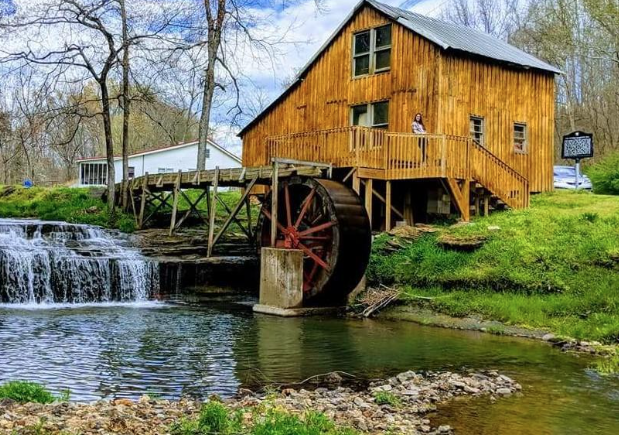
Interest in preserving the site grew gradually. Less than a year after his father passed away, Grady became determined to preserve his family’s heritage. He tracked down the original family to whom the old cast iron waterwheel was sold in the 1930s during the decline of mill operations. It took a midsized crane and a semi tractor trailer to move the wheel back to its original spot. Grady wondered in awe at how it was done with a team of mules originally. Local newspapers featured articles on its potential, sparking wider interest beyond just preservation but to also include events and a place for venues.
Organizing the Restoration Effort
The restoration gained structure when a small group of preservationists partnered with the local historical society to acknowledge and highlight the project. Grady brought in machinists, lumber specialists, craftsmen, excavators, and engineers that were experienced in working with precision centered projects, thus ensuring that safety and authenticity guided every decision. The collaborative effort became a model of local cooperation.
Before any work began, the team conducted a thorough assessment of the building’s condition and documented original features—wood joinery, gear mechanisms, even weathered signage—that would shape the blueprint for restoration. These details proved crucial in maintaining the mill’s character while meeting current safety standards.
Restoring the Structure and Its Features
Repairing the mill meant more than just strengthening its framework required a careful balance between modernization and historical fidelity. A local steelworker and engineer rebuilt the rusted buckets of the waterwheel with sheet metal. The copper sleeves that the axle turned in were replaced with railroad boxcar wheel ball bearings. These three-inch ball bearings were the largest that could be found for the axle of the waterwheel. However, the axle was four inches in diameter. The solution was to shave off an inch of the diameter of the axle at the tip where the wheel rested on two concrete pillars.
Only one of the grindstones had been preserved all these years. However, when the water was drained for the pond, the other grindstone was found in the bottom of the pond where it had rested for over 70 years after falling through the floor of the mill into the pond during its decline. Plans are underway to further restore its authenticity, including grinding corn into mill as a novelty item for visitors.
The Mill’s Role Today
Today, the Sim Corder Mill stands as a symbol and a gathering place. Visitors can walk around its restored exterior, watch the water flow through the flume, watch the wheel turn, listen to the soothing sound of the waterfall, and learn how the rhythms of rural life once revolved around its grindstones. Local residents view the mill as one of the most cherished landmarks in the region. Its success has inspired similar preservation efforts in nearby towns, showing what’s possible when heritage is treated not as a relic, but as living memory.