











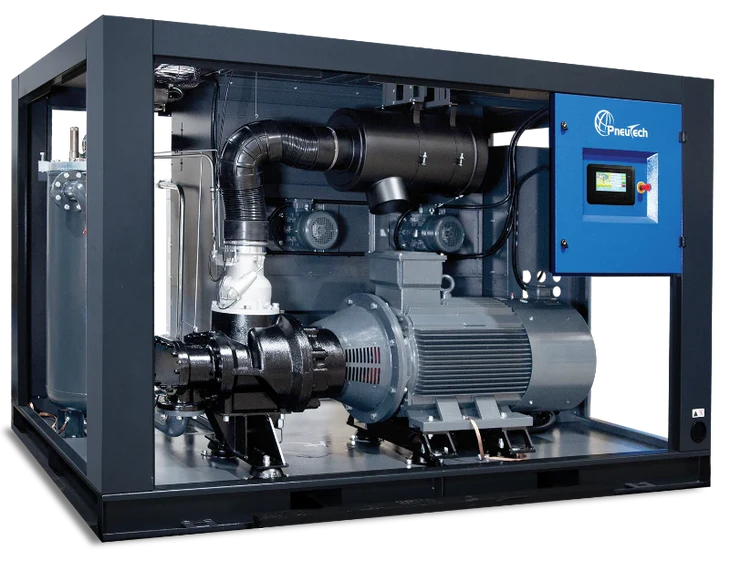











The Evolution of Compressed Air Technology Through Rotary Screw Design
Compressed air has long been a quiet force powering nearly every corner of industry—from precision manufacturing lines to heavy construction equipment. Its flexibility, reliability, and sheer utility have made it indispensable for operations that depend on consistent power without combustion or direct electricity. Yet behind this everyday utility lies a fascinating story of engineering refinement.
The journey from early piston-driven mechanisms to the fluid, continuous motion of Pneutech compressors reveals more than mechanical progress—it reflects a deep understanding of efficiency and endurance. Each innovation in air compression design has addressed the industry’s growing demand for cleaner, quieter, and more durable systems. Over time, engineers reimagined how air could be compressed not as a sequence of bursts but as a seamless stream of energy.
This transformation redefined performance standards, reducing downtime and operational waste while unlocking new levels of control. The evolution of rotary screw design, in particular, marks one of the most meaningful advances in the modern industrial landscape.
Early Foundations: The Age of Reciprocating Air Compressors
Before the world turned to rotary motion, the reciprocating air compressor stood as the cornerstone of early industry. Using a piston-and-cylinder setup reminiscent of steam engines, these machines generated pressurized air through a repeating back-and-forth movement. They were robust, familiar, and remarkably versatile, powering factories, trains, and early pneumatic tools.
Here are five key characteristics of reciprocating air compressors:
- Positive Displacement: They trap a fixed amount of air and compress it.
- Intermittent Flow: Air is delivered in pulses rather than continuously.
- High Pressure Capability: Often excel at reaching very high pressures.
- Maintenance Intensive: Due to many moving parts and friction.
- Historical Significance: Pivotal in early industrial development.
The reciprocating model represents an important stage in technological evolution—an era defined by ingenuity and mechanical simplicity. Yet as industries scaled and demanded continuous production, the need for a smoother, more efficient system became unavoidable. The groundwork laid by these early compressors set the stage for a shift that would permanently alter how compressed air systems function across the industrial world.
Innovation Breakthrough: Birth of the Rotary Screw Concept
In the early 20th century, a new approach to air compression emerged—the rotary screw system. This design abandoned the stop-and-start rhythm of pistons in favor of continuous motion, achieved through two interlocking rotors. As the rotors turned, they trapped and compressed air in a constant, fluid stream, eliminating much of the vibration and wear seen in older technologies. This engineering leap marked the birth of modern air systems. Compressors rotary screw became known for their quiet operation, efficiency, and reliability, quickly finding applications in manufacturing, food processing, and energy sectors. Companies such as Pneutech compressors further advanced the concept by improving precision machining and sealing techniques, ensuring minimal energy loss. Unlike reciprocating models, these systems offered constant pressure without fluctuation, ideal for environments requiring uninterrupted performance. The rotary screw concept redefined what compressed air could be—not just a utility, but an integrated system capable of running complex, continuous operations with remarkable stability and longevity.
Refinement and Expansion: Postwar Industrial Adoption
After World War II, industrial production surged, creating a demand for faster, more reliable air systems. This period marked a turning point for rotary screw technology as materials science and precision machining matured. By the 1950s and 1960s, industries such as automotive manufacturing and aerospace engineering began adopting these machines on a wide scale. The balance of continuous airflow and low maintenance transformed how factories operated.
| Feature | Reciprocating Compressors | Rotary Screw Compressors |
| Airflow | Intermittent, Pulsating | Continuous, Smooth |
| Noise/Vibration | High | Low |
| Maintenance | Higher, More Frequent | Lower, Less Frequent |
| Efficiency | Varies, can be high at max load | Consistently High |
| Application | Niche, high-pressure, portable | Broad industrial, continuous use |
Modern Engineering: Efficiency, Control, and Reliability
The past two decades have brought digital precision into compressed air systems. Advanced sensors, electronic controllers, and variable speed drives have redefined efficiency standards for industrial air. Intelligent software now monitors temperature, load, and energy consumption in real time, automatically adjusting output to match operational demand.
This ensures compressors perform optimally while reducing unnecessary energy use. Pneutech compressors integrate these features to deliver a balance between productivity and sustainability, turning air compression into a measurable, controllable process rather than an energy drain.
Modern rotary screw systems also feature innovative lubrication and cooling designs that minimize wear and extend lifespan, reducing maintenance downtime. Predictive analytics allow technicians to anticipate issues before they escalate, transforming service schedules from reactive to proactive.
Comparative Perspective: Rotary Screw vs. Reciprocating Systems Today
Despite technological evolution, both rotary and reciprocating systems retain their place in modern industry. The reciprocating air compressor remains relevant for small-scale, intermittent operations—its simple mechanics and low upfront cost make it ideal for workshops and maintenance crews. In contrast, compressors with rotary screw dominate continuous-use environments like manufacturing and energy plants, where stability and energy efficiency matter most.
The difference lies not just in performance but in philosophy: reciprocating models thrive on bursts of power, while rotary systems embody steady-state operation. The former serves precision; the latter ensures endurance. Maintenance also divides the two—rotary designs require consistent but less frequent care, while reciprocating units often need manual inspection due to wear-prone parts.
Conclusion
From the clattering pistons of early factories to today’s whisper-quiet, digitally managed systems, the story of compressed air technology mirrors industrial evolution itself. Each era has pushed the limits of precision, efficiency, and endurance—transforming air from a mechanical byproduct into a managed source of power. Rotary screw design stands as a testament to that progress: an invention that replaced repetition with continuity and friction with flow. Yet the journey is far from over. As engineers refine materials, integrate intelligence, and pursue sustainability, compressed air will continue to shape the rhythm of modern production. The evolution of this technology is not a closed chapter but an ongoing conversation between innovation and necessity—an art of turning invisible energy into enduring motion, generation after generation.