








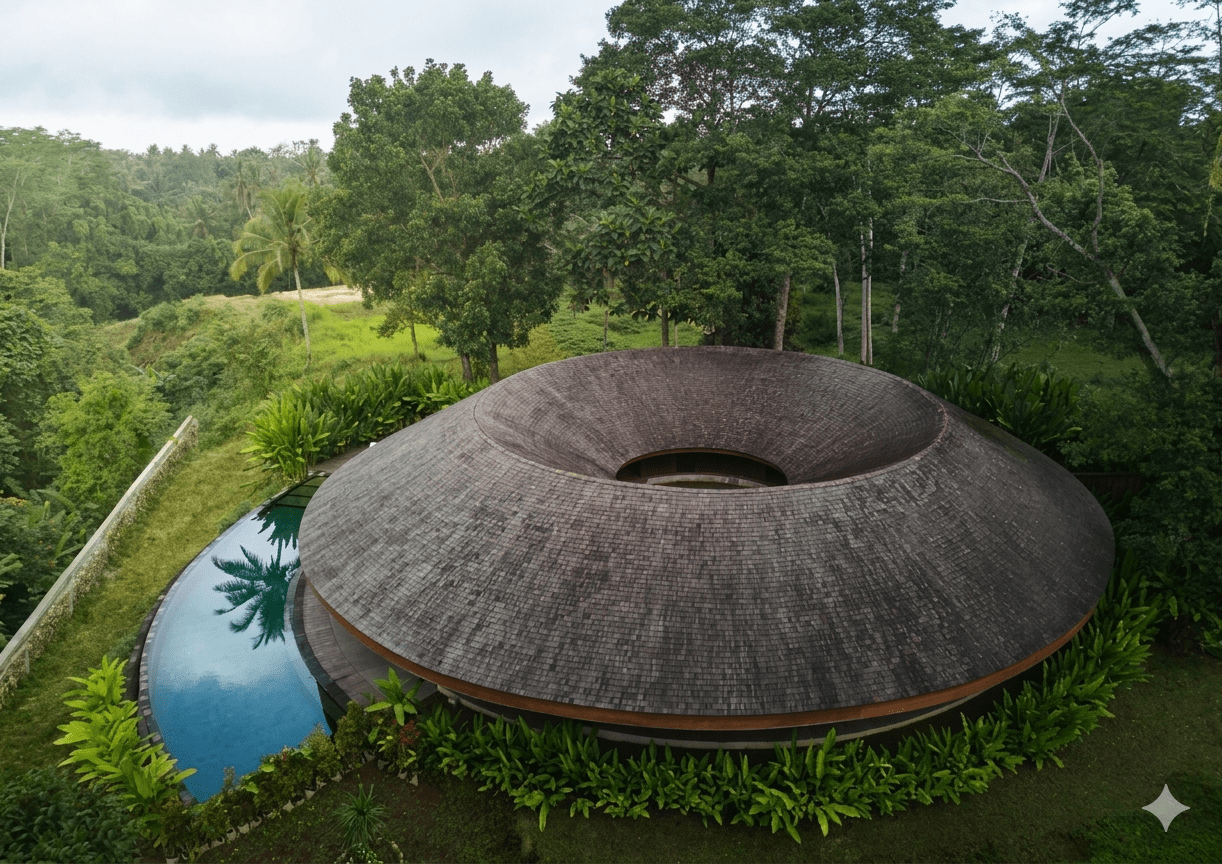











Payangan Retreat and the Architecture of Landscape in Bali
Set in Bali’s highlands, Payangan Retreat brings together architecture, landscape, and daily life through a circular plan that feels both calm and highly resolved. The project stands out not through excess, but through a clear spatial idea, a close response to nature, and a careful reading of how a retreat should be experienced.
Bali’s architecture is increasingly shaped by place and climate
Bali has become a distinctive setting for architecture that is shaped as much by climate and topography as by form. Some of the island’s strongest projects are those that feel inseparable from their surroundings, using openness, shade, material, and outlook to support a way of living that remains closely tied to the landscape.
That context matters because architecture in Bali is rarely just about appearance. Buildings must work with humidity, daylight, airflow, and the rhythms of outdoor life. When handled well, the result is not simply a visually striking project, but one that feels natural to inhabit.
Payangan Retreat begins with one clear idea
Payangan Retreat, listed by the studio as Villa Omah Prana Payangan, is a 475-square-metre residential rental project completed in 2022 in the highlands of Payangan. What makes it immediately distinctive is its ring-shaped plan, with rooms arranged along the perimeter and turned towards the surrounding landscape.
That single move gives the project both identity and order. Rather than breaking the retreat into competing volumes, the plan is held together by one continuous geometric idea. The living room opens to both the courtyard and the exterior, creating a fluid threshold between inward calm and outward connection, while the more private rooms remain sheltered and enclosed.
Geometry shapes the experience of the retreat
The most interesting aspect of Payangan Retreat is the way geometry is used to guide experience rather than simply create an image. Concentric circles organise not only the plan, but also the pool, paths, and built-in elements, giving the entire project a quiet internal rhythm.
This makes the retreat feel especially coherent. Movement through the space is continuous, transitions are softened, and the distinction between communal and private areas is easy to understand. The circular plan does not feel like a gesture imposed from above. It feels lived in because it shapes how the retreat is used from one moment to the next. That is where the design gains much of its strength.
There is also something fitting about this approach in a retreat setting. A project of this kind needs to support rest, gathering, privacy, and a slower sense of time. Here, the plan creates a natural continuity that makes those shifts feel intuitive rather than overly programmed.
The project stays closely connected to nature
For all its formal clarity, Payangan Retreat never feels detached from its environment. By turning the rooms outwards, the architecture keeps the surrounding landscape visually present throughout the project. Even with a courtyard at its centre, the retreat does not become inward-looking. Instead, it balances enclosure and openness in a way that suits both the site and the climate.
Materiality deepens that connection. The project draws from Bali’s weaving traditions through herringbone brickwork, interlaced wall textures, and subtle geometric motifs. These references are handled with restraint, adding tactility and cultural depth without distracting from the clarity of the plan. The result feels grounded in place rather than simply decorated with local cues.
The architect’s role is felt through clarity rather than presence
Payangan Retreat also reflects a careful architectural sensibility behind the work. Designed by an architect based in Bali, the project shows how a clear concept can shape structure, atmosphere, and lived experience without ever becoming overbearing. The architectural thinking is evident, but it stays where it should: within the quality of the project itself.
That balance is important. The retreat does not read as a statement about authorship. Instead, the design discipline sits quietly in the background, visible through the consistency of the geometry, the control of the layout, and the way the building remains open to the landscape around it.
Payangan Retreat reflects a wider direction in Bali architecture
Projects like Payangan Retreat point to a broader direction in Bali architecture, where buildings are increasingly conceived as part of the landscape rather than separate from it. This approach depends on close engagement with site, climate, and local craft, and it is part of what continues to make Bali such a compelling place for contemporary design.
That is what gives this project its lasting appeal. Payangan Retreat is led by one strong idea, but it never feels rigid. Instead, it feels calm, immersive, and fully tuned to its setting, which is exactly what the best architecture in Bali continues to achieve.