








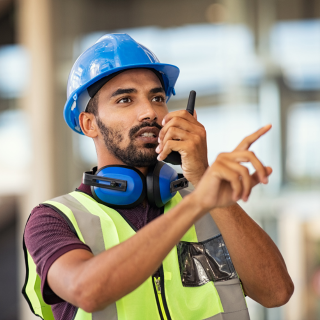











The construction industry is a diverse sector with roles ranging from warehousing to on-site building and demolition so a sector such as this requires a method of communication that is equally flexible. Two-way radios stand apart as the obvious solution for this industry, enhancing health and safety outcomes as well as productivity.
In a warehouse with heavy machinery and continuous background noise, hands-free two-way radios with noise cancelling features allow workers to communicate effectively, coordinating tasks and reducing the risk of workplace accidents.
In the field, two-way radios allow supervisors to remain in constant contact with their teams, providing guidance, direction and coordination to optimise their working day and adapt to changing site conditions.
The challenges of clear communication
Construction sites, builders’ merchants and warehouses are environments that often present communications challenges due to background noise, movement of heavy machinery and metal racking and thick walls which can distort radio waves. Two-way radios overcome these challenges, making them an essential tool for construction industry workers.
High noise levels
Building sites are inherently noisy environments, with machinery, vehicles and tools operating almost continuously. This near-constant thrum of background noise can make it hard to communicate in person and by telephone, however, ruggedised two-way radios designed for the construction industry feature noise-cancelling technology along with a loud and clear audio output, helping messages to be heard and understood even in the most demanding conditions.
Large or complex environments
Often, construction workers are required to erect infrastructure on signal dead zone sites such as large, rambling fields, multi-level structures and underground spaces. Without an effective method of communication, workers in these environments may need to check in regularly in person to confirm their safety, which detracts from productive time. Two-way radios and signal enhancing technology can overcome this issue, allowing workers to check in via their digital radio and remain connected, wherever they are on site.
Fast decision-making and changing priorities
When an issue arises on site, plans must be changed and those changes must be communicated in the most efficient manner to all affected personnel to reduce the risks of confusion, unnecessary downtime and safety failures. Two-way radios allow supervisors to immediately contact all affected personnel on a one-to-many channel, keeping them informed and maintaining progress on the project.
Lone working and high-risk roles
Many roles in construction are classified as high risk or lone worker and these personnel have a duty to keep themselves safe and report in regularly during their shift. Issuing personnel in high risk or lone worker roles with two-way radios allows them a direct line of contact to the site office or supervisor, enabling them to request backup or assistance as needed or to provide project updates.
Why construction workers need two-way radios
Construction workers have a unique set of communications needs. They need a robust communications solution that is easy to use and eminently reliable. It must be rugged enough to withstand the demands of the construction environment, have a simple user interface and offer group and one-to-one communication.
While a ruggedised mobile phone has its uses, the two-way radio far surpasses it in terms of convenience, with push-to-talk functionality enabling immediate contact with only one button push, background noise cancellation providing clearer audio and advanced features such as lone worker and GPS location delivering enhanced safety outcomes.
Benefits of construction site two-way radios
Two-way radios offer numerous benefits to the construction industry, supporting the achievement of operational KPIs as well as improving safety outcomes.
Improved productivity
Unexpected downtime is one of the greatest causes of productivity loss in the construction industry and this is often caused by miscommunications and a lack of clarity. With a two-way radio, workers can immediately seek advice or request materials, ask questions and report progress without leaving their work area. By streamlining communications through the use of a tailored communications solution, teams remain focused and downtime is minimised.
Enhanced site security
Construction sites are routinely targeted by criminals wanting to obtain tools and materials so securing the site is of the utmost importance. Security patrol teams can use two-way radios to monitor activity on the site, manage the access points and respond swiftly to any incidents that arise. By issuing two-way radios to all security personnel, valuable assets can be better protected and unauthorised access prevented, safeguarding the site, its workers and contents.
Effective deployment of manpower
As tasks and priorities change, so too must manpower be redirected to best effect. Two-way radios allow supervisors to reassign tasks and redirect teams at the touch of a button, responding proactively to evolving project priorities while minimising disruption and ensuring that resources are used efficiently.
Individual and group calling functionality
One of the features that sets two-way radios apart from other modes of communication is the ability to issue and receive both individual and group calls from the same handset. This allows for private conversations to be held as needed while also broadcasting group messages such as safety announcements and emergency instructions when required. This versatility makes the two-way radio the tool of choice for the construction industry.
Resilience to outdoor conditions
Construction sites, builders merchants and warehouses are all considered to be highly challenging environments for electrical equipment due to the constant presence of dust, moisture, vibrations and temperature fluctuations. While many other forms of communication fail in such environments, ruggedised two-way radios thrive due to their strengthened casings and weather-resistant designs, ensuring long-term, consistent and reliable performance.
Extended site coverage
Where a construction site is spread across a vast area, repeaters and signal boosters can extend the two-way radio frequency reach, allowing communication across the entirety of the site without having to depend on sometimes-unreliable mobile phone signals.
Faster emergency response times
In an emergency, every second counts, so it is of the utmost importance that workers can alert supervisors and emergency teams the second a serious incident or accident occurs. Many two-way radios are equipped with emergency alert buttons that trigger an immediate emergency response, with the possibility of saving lives.
Extended battery life
Unexpected downtime due to equipment failures can challenge a project’s schedule so two-way radio batteries are designed to last at least an entire shift on a single charge, keeping workers connected for the entirety of their working day.