












Timber Cladding’s Technical Evolution
Timber cladding has evolved significantly over the past two decades. Once associated primarily with low-rise residential and heritage projects, enhanced timber systems are now specified within commercial and institutional buildings where regulatory scrutiny and performance expectations are considerably higher.
This shift has been driven by two parallel developments:
- Refinement of traditional surface carbonisation techniques
- Advances in fire classification testing and treatment technology
Together, these innovations have repositioned timber as a technically credible façade material within modern compliance frameworks.
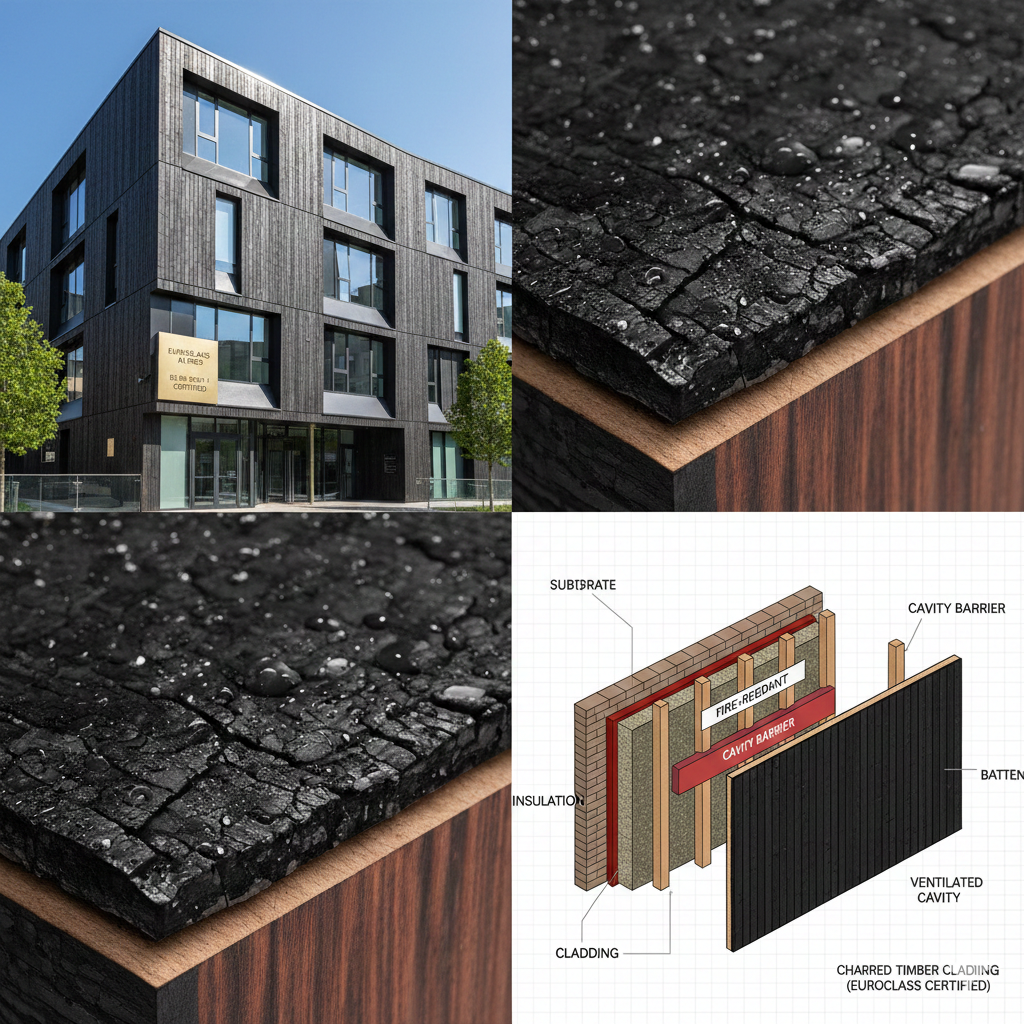
A design reference to traditional Japanese charred timber demonstrates how historic carbonisation methods have influenced contemporary façade expression while contributing to surface resilience.
Today, timber is assessed not only for appearance, but for durability, dimensional stability and regulatory integration.
Surface Carbonisation: Performance Beyond Aesthetics
Traditional charring involved controlled burning of the outer timber surface to create a carbonised protective layer. Modern processes refine this through controlled burn depth, stabilised brushing and consistent factory finishing.
Technically, carbonisation:
- Increases surface density
- Slows moisture penetration
- Improves UV resistance
- Reduces surface erosion
The char layer enhances durability while maintaining the board’s structural integrity. However, carbonisation does not automatically improve regulatory fire classification. Under UK standards, compliance requires formal testing in accordance with BS EN 13501-1.
This distinction is critical in commercial specification.
Euroclass Classification and System-Based Compliance
Reaction-to-fire performance in the UK is categorised under BS EN 13501-1 through Euroclass ratings. These classifications measure how materials contribute to fire development.
In many projects — particularly multi-storey and public buildings — defined Euroclass thresholds must be achieved.
A technical explanation of Euroclass fire performance timber cladding outlines how timber can form part of compliant assemblies when supported by certified fire-retardant treatments.
It is essential to understand that compliance is determined by the complete wall build-up, including:
- Insulation type
- Cavity barrier strategy
- Substrate
- Ventilation detailing
Fire performance is system-based, not material-only.
Fire-Retardant Treatment and Durability
To enhance reaction-to-fire classification, timber may be factory-treated with fire-retardant solutions tested to recognised standards.
Specification teams must evaluate:
- Suitability for external exposure
- Long-term treatment durability
- Maintenance requirements
- Compatibility with finishing systems
Fire-retardant treatment addresses regulatory performance, while carbonisation enhances surface resilience. These processes serve different objectives and must not be confused.
Correctly specified, treated timber can satisfy regulatory requirements while retaining architectural character.
Dimensional Stability and Moisture Behaviour
Façade performance depends heavily on moisture movement. Untreated softwood absorbs and releases moisture, resulting in:
- Board movement
- Cupping
- Fixing stress
- Surface checking
Thermal modification reduces hygroscopic behaviour by altering the timber’s cellular structure, lowering moisture absorption by up to 40–50%.
Although separate from carbonisation, thermal modification may be incorporated alongside fire-retardant treatment within performance-led systems. Reduced dimensional movement improves façade alignment and long-term reliability.
For commercial consultants, stability is as important as classification.
Ventilated Rainscreen Integration
Timber cladding is commonly installed within ventilated rainscreen systems. This configuration:
- Allows drainage
- Promotes airflow
- Reduces moisture dwell time
- Protects structural substrate
However, cavities must be detailed in accordance with fire strategy. Continuous cavity barriers are essential to prevent vertical flame spread.
Successful integration requires coordination between fire engineers, façade consultants and contractors. When correctly detailed, performance-enhanced timber systems can meet both environmental and compliance objectives.
Lifecycle Performance and Asset Value
Modern projects increasingly evaluate façade materials over 25-year plus horizons.
Performance-enhanced timber offers:
- Extended service life
- Reduced repainting cycles
- Lower distortion-related maintenance
- Stable visual consistency
Charred finishes slow surface weathering. Fire-retardant treatments maintain regulatory performance. Thermal modification improves stability.
Combined strategically, these enhancements support predictable maintenance planning and long-term asset resilience.
Comparative Performance Snapshot
| Performance Factor | Untreated Softwood | Charred Timber | Fire-Treated Timber |
| Surface Durability | Moderate | Improved | Moderate |
| Reaction-to-Fire | Lower baseline | Test dependent | Enhanced when certified |
| Dimensional Stability | Variable | Dependent on base timber | Dependent on base timber |
| Moisture Behaviour | High absorption | Reduced at surface | Dependent on substrate |
In contemporary construction, balanced enhancement strategies deliver both aesthetic impact and measurable performance.
Key Takeaways
- Carbonisation enhances surface durability but does not replace fire classification testing.
- Reaction-to-fire compliance depends on the full wall assembly.
- Fire-retardant treatment must be certified for external exposure.
- Thermal modification improves moisture stability.
- Ventilated rainscreen detailing is critical.
- Whole-life modelling increasingly favours stability-driven materials.
Performance timber cladding reflects the convergence of heritage technique and modern regulatory science. Through controlled carbonisation, fire-retardant treatment and system-based integration, timber has evolved into a technically credible façade solution within compliance-driven construction environments.