

















If you’ve worked on construction projects in the South East of England, you know ground conditions are never straightforward. Whether it’s heavy London clay, weak soils next to rivers and estuaries or unpredictable chalk, there are different and challenging ground conditions at every turn.
The variety in ground conditions in this part of England makes foundation design both interesting and sometimes frustrating. Due to these challenging ground conditions, screw pile foundations are now much more common in the region, mainly because of the local geology.
What’s actually under the South East?
The South East is one of the most geologically varied parts of England. The North Downs run through Surrey and Kent as a broad chalk ridge. The South Downs cross Sussex in a similar arc before reaching the coast. Between them is the Weald, made up of Wealden clay, sandstone, and greensand, which behaves very differently from the chalk on either side.
As you move toward the coast, the ground changes again. Estuaries, coastal plains, and reclaimed land bring soft alluvial deposits and high water tables. The Thames Basin to the north adds river gravels and London Clay to the mix.
The British Geological Survey maps all of this in detail. These maps are useful if you want to understand why ground investigations can give such different results even within a short distance.
Where traditional foundations can struggle
Strip foundations and standard pad footings work well in stable, consistent ground. The South East doesn’t always offer that.
Clay soils can shrink and swell. London Clay and Wealden clay, found in much of Surrey, Kent, and the Sussex interior, contract in dry summers and expand in wet winters. This seasonal movement puts strain on rigid concrete foundations over time. It’s a common problem in thousands of properties across the region.
Chalk acts differently. It may look solid on the surface, but it often hides voids, cracks, and soft spots that only show up when you start digging. This makes it hard to choose the right foundation depth with confidence. Mistakes can be costly.
Waterlogged ground near the coast or in river valleys adds more challenges. Pouring concrete in areas with a high water table is slower and more disruptive than most clients expect.
How screw piles handle the variation
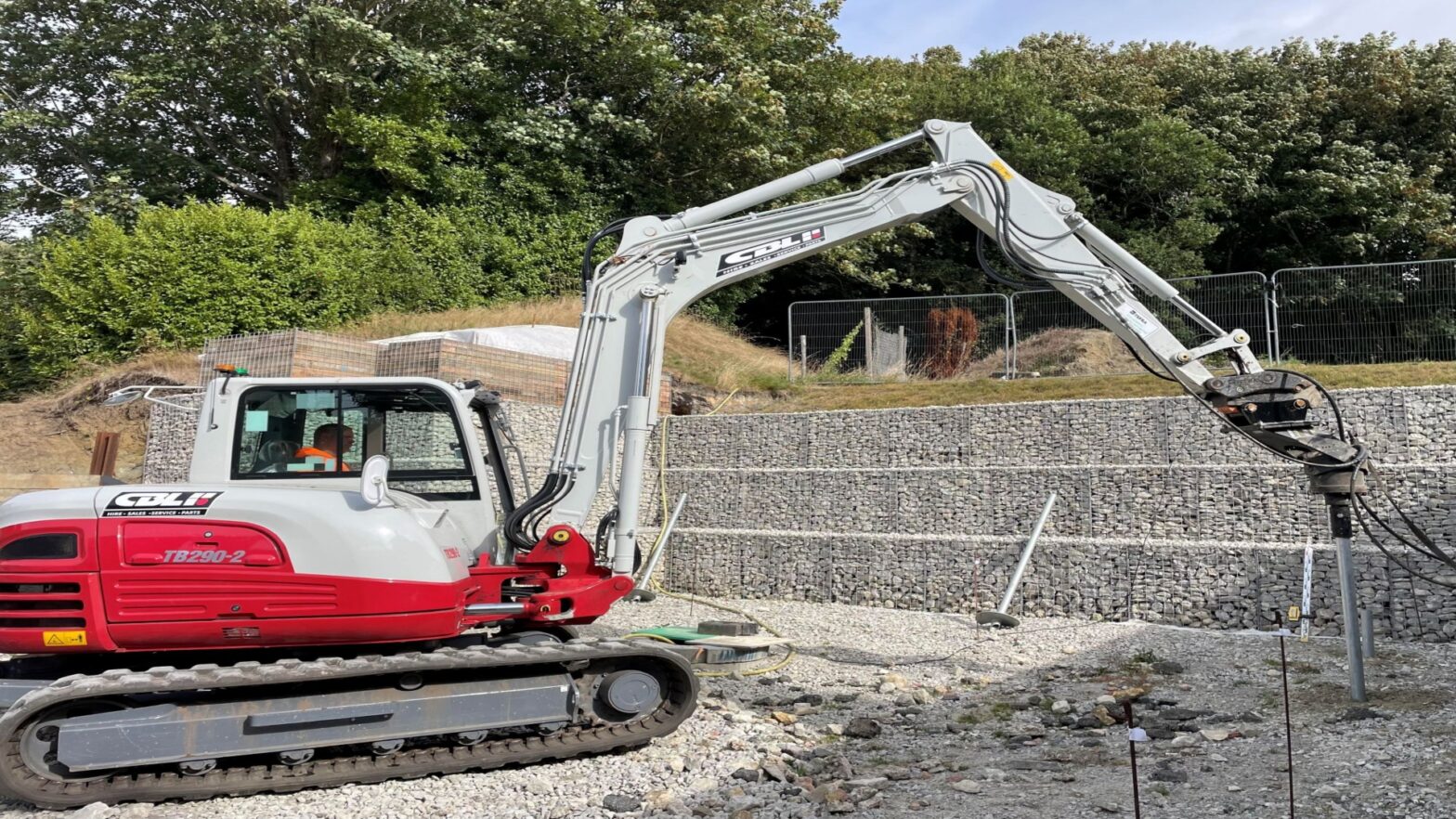
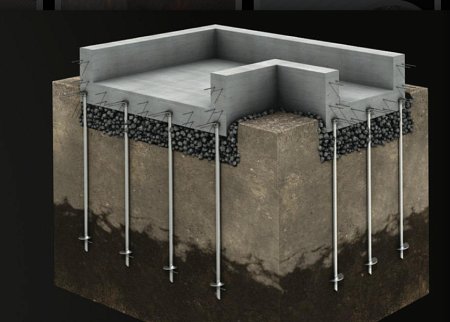
Screw piles are steel shafts with welded helix plates, installed into the ground using a hydraulic motor. They work well in variable ground because they adapt to the real conditions on site, not just what the drawings suggest.
Torque data taken during installation shows how the pile is performing as it moves through different layers. The pile is driven to whatever depth gives enough bearing capacity, whether that’s two metres or eight, depending on the site. If there’s a soft zone partway down, the process continues until the pile reaches solid ground.
In chalk, screw piles can go through the weathered upper layer and anchor into stronger rock below. In clay, the helix plates spread the load over a larger area. The pile itself is not affected by the shrinking and swelling that damages surface foundations.
East and West Sussex show this clearly. A project on chalk downland above Lewes sits on very different ground compared to one on Wealden clay near Uckfield. The same foundation system, when specified correctly for each site, works in both cases.
Practical advantages of South East sites
There are also practical reasons, beyond geology, why screw piles work well in the South East.
The South Downs National Park, several Areas of Outstanding Natural Beauty, and many conservation areas mean planning rules often limit the equipment you can use and how much disruption you can cause. Screw pile rigs are compact and installation is quiet. There are no concrete trucks and no major excavation. If you are on a plot with narrow access or near a listed building, this makes a real difference.
Speed is another advantage. A typical residential project takes just a day or two. The foundation is ready to build on immediately, with no curing time needed. For self-builds and extensions with tight schedules, it’s worth considering this from the beginning.
Ground conditions are manageable, not a barrier.
The South East’s geological variety isn’t a problem to avoid. It’s simply something to consider during design. Chalk, Wealden clay, and coastal alluvium can all be handled with screw pile foundations. Ground conditions are rarely the barrier people think they are.
It’s important to understand what you’re building on with an initial ground survey. That’s usually the most useful conversation to have at the start. If ground conditions don’t look favourable for concrete foundations, screw pile foundations could be the right option for your next construction project.