





















The global sleep products market is at a key turning point. It is moving away from a decade of venture-funded direct-to-consumer (DTC) growth and into a more practical era focused on combining online and in-store sales.
From 2015 to 2023, technology reshaped the industry, with vacuum-packed foam mattresses aiming to replace the need for traditional showrooms.
But the 2025 sale of Simba Sleep to Sleep Country Canada stands as clear proof that the online-boom has come to an end.
According to Antony Colton, Marketing and Communication specialist at Bedstar, this shift highlights an important truth: the digital-focused approach overlooked the challenges tied to the emotional and physical nature of big-ticket sleep purchases.
Today’s retail world shows two major trends: smaller marketplace sellers are struggling because customer acquisition costs keep rising, while bigger players like Dreams and Bensons for Beds are opening more physical “slowrooms.”
Digital-first brands are facing problems as their return rates almost doubled between 2023 and 2025, while established stores are using technology to refine the “try before you buy” approach, turning mattresses from risky online purchases into reliable health-focused choices.
The Ups and Downs of Online-Only Innovators
The “Bed-in-a-Box” (BIAB) idea started with the belief that skipping retail costs could let companies offer better deals while still making good profits.
This concept thrived thanks to low interest rates and funding from venture capital firms that prioritized top-line growth.
Companies used vacuum-compression shipping to cut delivery expenses, but by 2025, these logistics turned into structural problems.
Eve Sleep, once worth hundreds of millions, was rescued from administration for a fraction of its peak valuation; in 2022, Bensons for Beds bought the brand for just £600,000, which was under 0.5% of its peak IPO worth.
The Simba Turning Point
Simba Sleep’s journey shows just how unpredictable the market can be. The company raised millions and utilized high-profile ambassadors like Gareth Bale, but its valuation took a significant hit during the slump in tech-driven appraisals.
In June 2025, Sleep Country Canada, owned by Fairfax Financial Holdings, acquired Simba for approximately £67 million, ending its run as an independent disruptor.
The deal, which ties payments to future performance, highlights investor caution around DTC valuations. While Simba reported its strongest-ever bottom line in 2024, its shift to a trade owner with a network of hundreds of physical stores hints that even successful online brands require a retail backbone to grow on a global scale.
The Shrinking Marketplace Tier
Beneath the top companies, the marketplace tier is facing major contraction. Smaller sellers on platforms such as Amazon are struggling to survive because customer acquisition costs (CAC) often exceed 30% of earnings. Financial trouble is widespread.
In August 2025, the global brand Sleep8 pulled out of the UK, leaving close to £20 million in unpaid debts after suffering a £10.6 million loss from a turnover of just £2.1 million. Similarly, Mammoth Sit and Sleep faced a surge in losses, with their deficit rising to £462,848 in the first nine months of 2024, forcing a financial reorganisation.
| Retailer/Brand | Status (2023-2025) | Outcome/Owner |
| Simba Sleep | Sold (June 2025) | Sleep Country Canada / Fairfax |
| Eve Sleep | Administration (2022) | Acquired by Bensons for Beds |
| Brook + Wilde | Liquidation (2023) | Rescued by Comfortex |
| Sleep8 | UK Exit (Aug 2025) | Ceased trading with £20m debt |
| Mammoth | Restructuring (2024) | Debt shortfall of £1.17m |
Return Rate Crisis: Logistics That Fuel Disappointment
The “Comfort Guarantee” aimed to ease buyers’ doubts but has led to a massive reverse logistics problem. In 2025, online shopping returns hit 16.9%, which is nearly twice the 8.9% return rate seen in physical stores. For furniture and bedding, those numbers jumped to 22.7% and 21.3%, respectively.
This “experience gap” emphasizes how people shopping online—particularly those buying furniture for the first time—return products 67% more often than experienced buyers. Showrooms provide hands-on proof that digital platforms simply cannot offer. The main reasons for returns include:
- Wrong Size: Space fit issues account for 58% of furniture returns, with 34% of customers stating items were “larger than expected.”
- Style Issues: 47% of home decor returns are due to style problems, showing how hard it is to convey texture and “feel” on a screen.
- Trouble with Assembly: Items requiring home assembly see return rates 67% higher than ready-to-use products.
When mattresses are returned, the financial loss is extreme. Once opened, a BIAB mattress cannot be repacked and requires expensive two-person collection. Cleaning and refurbishing returns adds further costs, often ending in a loss once the Net Profit margin.
When return rates exceed 20% and CAC stays above 30%, profit margins vanish. Key reasons for returns include:
- Size Issues (58%): Items being larger than expected for the home space.
- Tactile Disappointment: Inability to judge texture or firmness online.
- Assembly Frustration: Products requiring home assembly return 67% more ofte
The Revival of Showrooms: Introducing the “Slowroom”
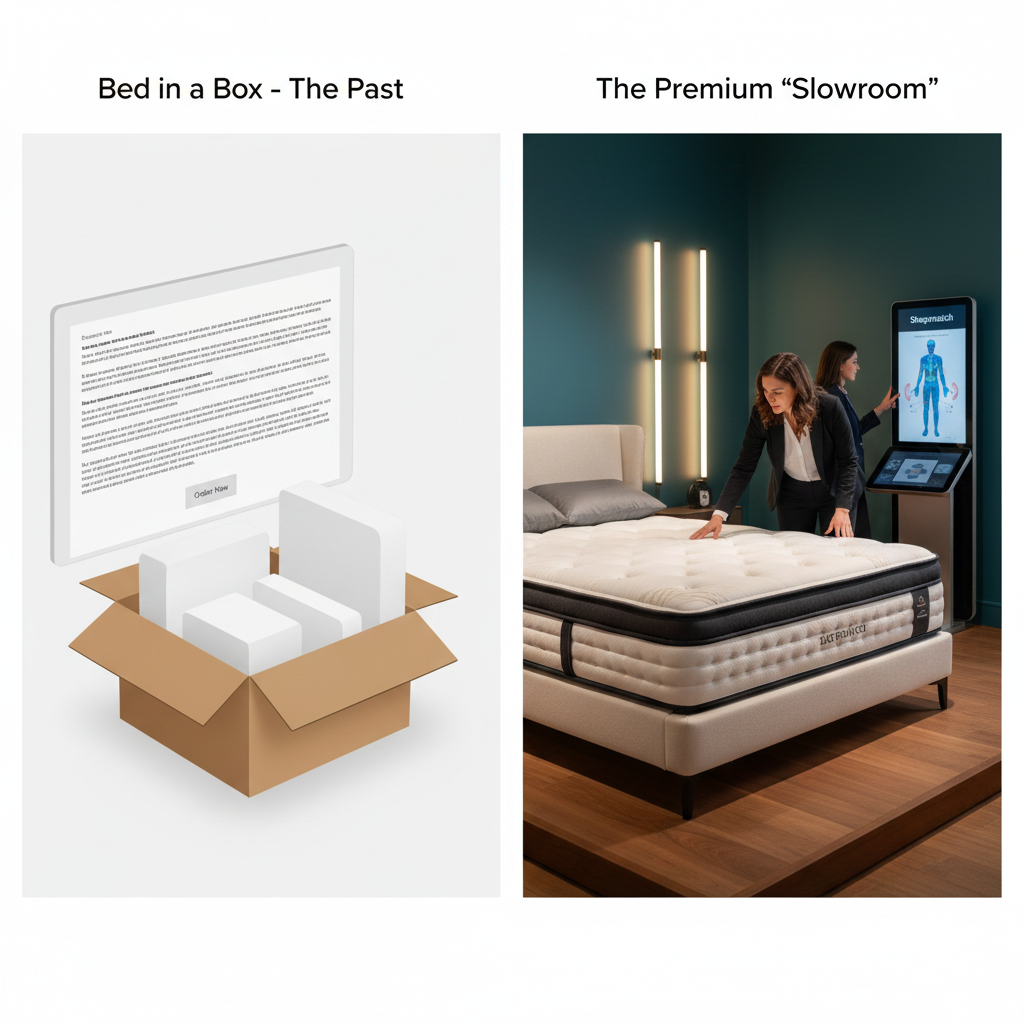
Regular retailers are putting significant investment into physical stores through the “slowroom” concept—high-end spaces meant to make shopping stress-free and help customers get their purchases right on the first try.
Dreams: Expanding the Premium Concept
Dreams, the top bed retailer in the UK, saw profits grow in 2024 after major spending on stores and technology. Their latest “premium concept” store in East Sheen focuses more on the shopping experience than on stocking large inventory.
- Sleepmatch Technology: This uses biometric mapping to recommend mattresses based on science instead of guesswork.
- Premium Brands on Display: Slowrooms showcase high-margin brands like Flaxby and Tempur, which are difficult to sell online with prices as high as £3,999.
Bensons for Beds: Back to the High Street
Bensons for Beds turned their finances around, going from a £15.4 million loss to an EBITDA profit of £1.5 million by the end of 2023. They plan to reach a target of over 200 stores again, shifting their focus to smaller stores in urban areas like the M25 where large retail parks are scarce.
| Metric | Dreams Plan | Bensons’ Approach |
| Store Design | Luxury “Slowrooms” | Compact High-Street Locations |
| Technology | Sleepmatch Biometrics | Integrated Click & Collect |
| Target Market | Premium (Flaxby, Tempur) | City Areas (M25 Priority) |
| Finances | Profits rising | Bounced back to profit (£1.5m) |
Mental Health, Wellness, and the Future with AI
Shoppers are returning to physical stores because they are tired of review fatigue and distrust online marketing claims. Critics note that online-only brands often hide important technical details—like foam density or the GSM of natural fibers—using unclear terms like “cloud-like comfort.”
Visiting a showroom gives buyers a chance to test products in person and avoid issues like premature sagging associated with the “no-turn mattress scam.”
In the UK, where the market reached approximately USD 1.23 billion in 2024, an aging population and growing focus on sleep health are driving demand.
Older buyers with orthopaedic concerns prefer in-person shopping for its tailored advice and professional help.
Modern showrooms combine technologies like biometric sensors and AI tools that assess body shape and sleep positions to create custom solutions like firmness zones, which online forms cannot replicate.
Macroeconomic Challenges and Sustainability
Regulatory restrictions have ended the era of unchecked digital marketing. In 2024, the Competition and Markets Authority (CMA) made Simba alter its online methods related to “fake” price discounts.
Starting in April 2025, the CMA gains new authority to impose fines of up to 10% of global turnover for misleading consumer practices, such as countdown clocks used for pressure selling.
Raw material costs are climbing, with polyurethane foam increasing by 12% due to supply chain issues. This is putting pressure on profits for online brands that rely on foam.
On the other hand, traditional companies are turning sustainability into a key strategy. Brands like Harrison Spinks use 100% natural, refillable materials, attracting customers concerned about the environment.
Major names like IKEA have also started mattress recycling programs to handle end-of-life processes—a challenge online-only brands often face.
Balanced Omnichannel Approach
The market in 2026 works as an integrated ecosystem. Online sales are expected to rise at a CAGR of 8.2%, but offline stores still make up 66% of the market.
Brands that succeed focus on a smooth experience between online and offline channels. For example, Simba used data to target high-value customers likely to complete purchases with retail partners, boosting ROAS by 30%.
Emma Sleep, named “Most Trusted” in 2026, has expanded into “find a store” locations to ease concerns about buying online.
| Segment | CAGR (2026-2031) | Driver |
| Commercial | 3.79% | Hospitality refurb (2028 events) |
| Online Channel | 3.48% | Urban digital-native consumers |
| Foam Segment | 3.02% | Tech upgrades/BIAB legacy |
| Residential | 2.74% | Renovation and replacement cycles |
Conclusion: Balancing Technology with Personal Connection
The “Bed-in-a-Box” trend marked an important time for changing industry logistics. By 2025, however, it’s clear that the “box” could not replace the “bed.” Consolidation, buyouts, and failures of online-only sellers prove that bad unit economics do not work without physical resources.
The “try before you buy” approach has returned because it meets the human need to test products, get expert guidance, and understand the emotional weight of investing in long-term health.
As “slowrooms” continue to grow, they shape a retail future that is more tech-friendly, eco-conscious, and focused on human needs.