













Federal regulations governing electric vehicle infrastructure in historic properties underwent significant revision in 2022, creating new pathways for integrating modern charging technology with heritage buildings. The Advisory Council on Historic Preservation approved an exemption that relieves federal agencies from certain historic preservation review requirements for electric vehicle supply equipment installation. Regulatory changes reflect growing recognition that sustainable transportation infrastructure must coexist with architectural preservation.
Chris Rapczynski, whose firm Sleeping Dog Properties specializes in historic construction, has developed approaches to electric vehicle integration that satisfy both technological requirements and preservation standards. His current project in Boston’s Louisburg Square exemplifies the sophisticated problem-solving required when 21st-century mobility needs intersect with 19th-century architectural heritage.
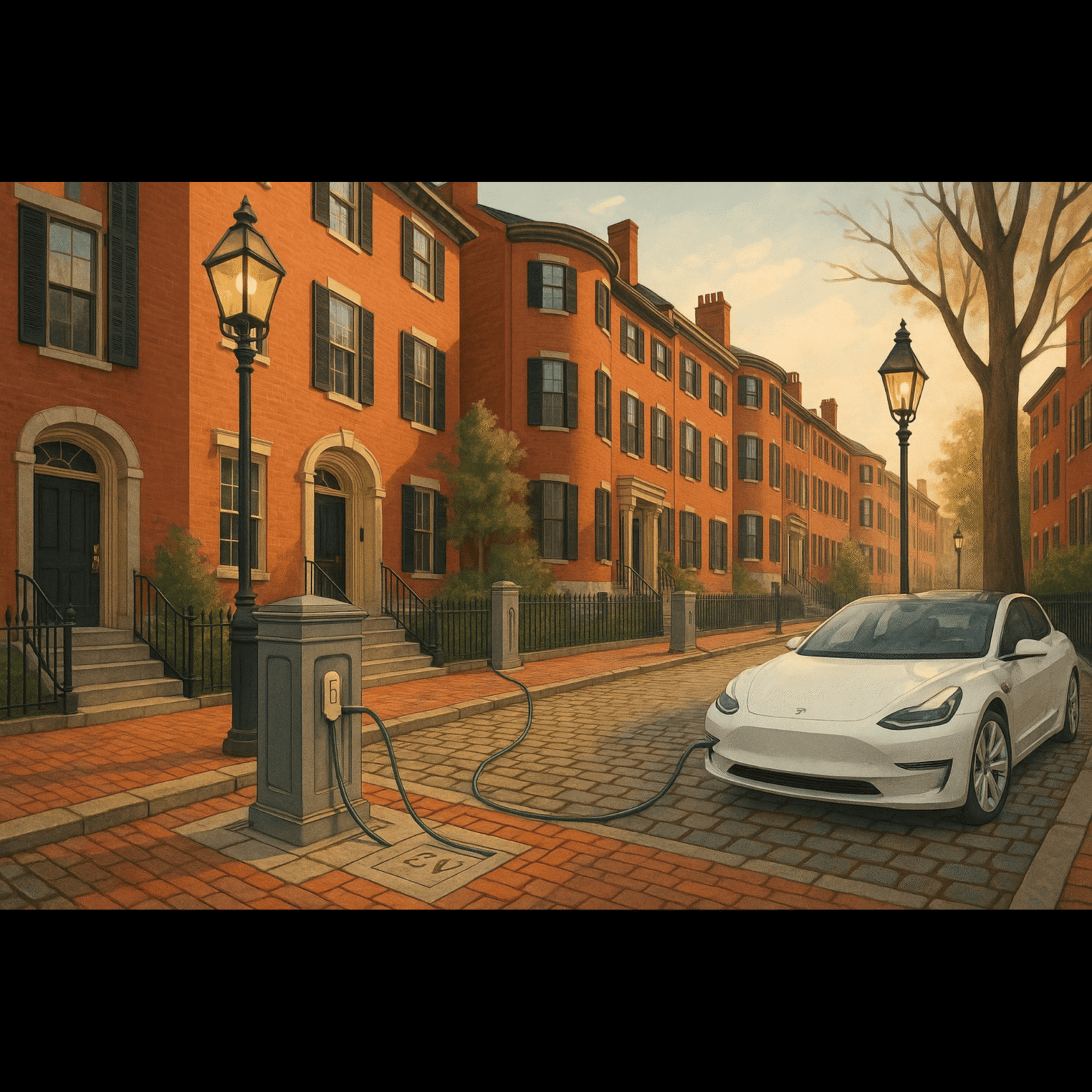
“We’re installing a Tesla car charging station underneath the brick sidewalk into a historic custom-made utility box that’s designed to look like a gas box, but instead of saying gas, it says EV,” Chris Rapczynski explains about the Louisburg Square installation. His project demonstrates the intersection of advanced engineering, historic preservation, and municipal coordination required for successful technology integration in protected districts.
Federal Framework Creates New Possibilities
Federal investment through the Infrastructure Investment and Jobs Act allocated $7.5 billion for electric vehicle charging infrastructure, including installations on historic properties and in protected districts. However, federal exemptions apply only to installations that meet specific criteria: they must use existing parking facilities, employ reversible installation techniques, minimize ground disturbance, and utilize colors complementary to the surrounding environment.
Boston’s historic districts operate under particularly stringent requirements administered by the Boston Landmarks Commission and individual neighborhood architectural review boards. Sleeping Dog Properties’ approach to regulatory compliance reflects deep understanding of both preservation requirements and modern infrastructure needs. Chris Rapczynski’s Louisburg Square project required coordination with utility companies, municipal authorities, and historic preservation officials to ensure compliance with multiple regulatory frameworks simultaneously.
“Sometimes we talk about where does this go in the future, because are we going to have electric car charging stations in front of every historic home? Is that where this is headed, and how does that get managed?” Chris Rapczynski notes, recognizing the broader implications of his work in EV integration.
Federal exemption criteria specify that installations must use “lowest profile equipment” and place charging infrastructure in “minimally visibly intrusive” areas. These requirements align with Sleeping Dog Properties’ design philosophy of seamless technology integration that preserves historic character while providing contemporary functionality.
Engineering Solutions for Heritage Buildings
Technical challenges of installing electric vehicle charging equipment in historic properties extend beyond aesthetic considerations to encompass structural, electrical, and utility infrastructure limitations. Nineteenth-century buildings were designed for gas lighting and coal heating, requiring creative engineering solutions to accommodate contemporary electrical loads and connectivity requirements.
Chris Rapczynski’s team has developed specialized techniques for introducing modern electrical infrastructure without compromising historic building integrity. Sleeping Dog Properties’ Louisburg Square installation demonstrates these capabilities through underground conduit routing, custom utility enclosures, and coordination with existing utility infrastructure that dates to multiple construction periods.
“The challenge with any historic building is that you’re frequently absolved of the responsibility to have the construction type meet the current code as it pertains to energy efficiency in a lot of ways because you’re working with an impossibility,” Rapczynski explains. “The only way you can meet those standards is if you tear the building down. If you tear the building down, you won’t have a historic building anymore.”
This fundamental tension between preservation and modernization requires solutions that satisfy contemporary performance requirements while maintaining architectural authenticity. Electric vehicle charging presents a particularly complex challenge because it requires substantial electrical capacity, accessible placement, and integration with both utility infrastructure and neighborhood aesthetics.
Sleeping Dog Properties has developed relationships with utility companies, electrical engineers, and custom fabricators to create solutions that meet these multiple requirements. The custom utility box designed for the Louisburg Square project exemplifies this collaborative approach, requiring input from historic preservation consultants, electrical engineers, and municipal utility departments to achieve successful integration.
Aesthetic Integration in Protected Districts
Federal guidance emphasizes using “reversible, minimally invasive, non-permanent techniques” for infrastructure attachment. This requirement aligns with preservation philosophy that modifications to historic properties should be reversible and distinguishable from original construction, allowing future generations to make different choices about technology integration.
Successful Tesla integration in historic districts requires understanding of architectural context, neighborhood character, and visual impact assessment. Louisburg Square, where Sleeping Dog Properties implemented their installation, stands among Boston’s most architecturally significant residential squares, with properties dating to the 1840s and strict oversight from preservation authorities.
The decision to design charging infrastructure that mimics traditional gas utility boxes reflects sophisticated understanding of neighborhood character and historic precedent. Rather than introducing obviously contemporary elements, Chris Rapczynski’s approach creates continuity with existing utility infrastructure while providing modern functionality.
“All those people who are living in there, in those communities, are now wanting to answer their lifestyle needs,” Rapczynski observes about residents of historic neighborhoods. This recognition drives his approach to technology integration: addressing contemporary requirements while respecting the architectural heritage that makes these neighborhoods desirable.
Coordinating Complex Approval Processes
The custom utility box solution required extensive research into historic utility infrastructure, materials specification that would weather appropriately, and fabrication techniques that could achieve period-appropriate aesthetics while housing contemporary electrical equipment. This attention to detail reflects broader understanding that successful preservation requires continuous adaptation rather than static preservation.
Successful installation of electric vehicle charging infrastructure in historic districts requires coordination with multiple municipal departments, utility companies, and preservation authorities. Boston’s permitting environment for EV charging reflects both the city’s commitment to sustainable transportation and its rigorous historic preservation standards.
Chris Rapczynski’s experience with the Louisburg Square project demonstrates the complexity of municipal coordination required for infrastructure installations. The project required approvals from the Boston Landmarks Commission, coordination with utility companies for underground service routing, and compliance with both electrical codes and historic preservation requirements.
“You have to be really vigilant about trying to preserve what it was because it’s so much more costly to make a mistake,” Rapczynski emphasizes. “So we sit walking on eggshells. Don’t touch the building envelope, or if you do photo document it and preserve it.”
Setting Precedents for Future Development
This cautious approach proves essential when working with experimental infrastructure installations in protected historic districts. The costs of compliance violations or installation errors can be substantial, both in terms of financial impact and project delays. Sleeping Dog Properties has developed systematic approaches to documentation and coordination that minimize these risks while enabling solutions.
California’s experience with EV charging permitting provides insights into streamlined approval processes that balance infrastructure development with regulatory compliance. However, Boston’s historic districts require additional layers of review that extend beyond standard building and electrical permits to encompass architectural review and preservation compliance.
Federal exemptions for EV charging installations apply primarily to federal agencies and federally funded projects, but establish precedents that influence local permitting processes. Private installations in local historic districts remain subject to local preservation authorities and architectural review boards.
Chris Rapczynski’s work with Sleeping Dog Properties demonstrates how contemporary infrastructure can be integrated into historic contexts without compromising architectural character or neighborhood aesthetics. “We deliver quality with the spare-no-expense mentality so that there’s never a project out there that we’ve done that’s not great,” he states about his firm’s commitment to excellence in both preservation and innovation.
The integration of Tesla charging infrastructure into 19th-century architecture demonstrates more than a technical achievement—it illustrates a philosophy of adaptive preservation that enables historic districts to remain viable, sustainable communities for contemporary residents while maintaining their architectural heritage for future generations.